Friday, May 4, 2012

Andreas Ratzlaff family emigration; Bremerhaven

Arriving in Bremerhaven, Germany, by train, the Ratzlaffs, Wedels and Unruhs boarded the SS Weimar on May 11, 1907 (SS stood for “steamship”).  See: http://www.norwayheritage.com/p_ship.asp?sh=weima or http://www.theshipslist.com/ships/lines/nglloyd.html for more details regarding the SS Weimar.  Here's a picture of the SS Weimar from 1891:


Here's a flyer from 1908 advertising the Norddeutscher Lloyd.  To the left is the shipping company's headquarters building in Bremen, Germany:


This map, from 1907, shows Bremerhaven, Germany, at the mouth of the river Weser in northern Germany.  The railway tracks entering the city from the south connect with Bremen, Germany, about 40 miles to the south:


Beginning in 1897, the Norddeutscher Lloyd began using the KaiserHaufen (“emperor port”) which had been specially constructed by the city of Bremerhaven to accommodate new, bigger steamships that were being used by the shipping company (http://en.bremerhaven.de/experience-the-sea/service-infos/city-history/the-kaiserhaefen-ports.24320.html
and
On this map from 1912, the KaiserHaufen can be seen to the north of AlterHafen (“old port”) and NeuerHafen (“new port”).  In German, railway station is Bahnhof.  The Guter Bahnhof (“better station”) can be seen just east of the KaiserHaufen, and from the Bahnhof, the train tracks come right down to the Norddeutscher Lloyd piers off KaiserHaufen and NeuerHaufen.  These may be the tracks that took the Ratzlaffs to the SS Weimar (Meyers Gazetteer of the German Empire).


Thursday, May 3, 2012

Andreas Ratzlaff family emigration; Bremen

Once in Bremen, Germany, emigrants planning to travel via Nord-Deutscher Lloyd Shipping Line would detrain and be housed in facilities maintained by the shipping company or its agents.  Marie (Ratzlaff) Penner tells us that the Ratzlaff party stayed at the “Pilliar Inn” for two weeks as they waited to board their ship.  I feel it’s possible that Marie may have mistaken “Missler” for “Pilliar”.  The Ratzlaff party had probably used the biggest Nord-Deutscher Lloyd agent, Friedrich Missler, to book their sea passage.  In 1907, Missler completed a facility known as the Missler Inn to house immigrants near Bremen as they were processed.  The inn, located in a municipality called Findorf just northwest of the City of Bremen proper, may have been completed by the time the Ratzlaffs arrived in May, 1907.  The inn was situated somewhat northwest of the Bremen central railway station.  The building was demolished sometime in the 1980s.  Today, the site is home to a retirement community named the Bremer Wohnstift Seniorenzentrum Findorff.  The address of the site is Walsroder Strasse 1, 28215, Bremen-Findorff.
The Missler Inn:


The Ratzlaffs, Wedels and Unruhs waited at the Inn for about two weeks.  Marie (Ratzlaff) Penner says that one of Ben Unruh’s daughters was diagnosed with an eye condition during the medical examination.  As a result, the party could either wait for her to get better or leave her behind.  In the end, an older son of Ben Unruh stayed behind with the sick daughter and the rest of the party continued on to the seaport which serves Bremen.  Bremerhaven lies about 40 miles north of Bremen and may have taken about an hour to reach by train.  The location of the Missler Inn is marked on the inset map of Bremen by the green "X".


The Unruh children who were left behind in Bremen were probably Jacob (age 17) and Helen (age 11) Unruh.  Helen probably suffered from trachoma, which was an eye disease and was a common ailment afflicting would-be immigrants in this time period.  I don’t know any more details of what became of Jacob or Helen, but GRANDMA does indicate that they both died in the United States.

Andreas Ratzlaff family emigration; train across Germany

After the Ratzlaffs, Wedels and Unruhs boarded the train in either Ratibor or Myslowitz, they would finally have truly been on their way to Bremen, Germany.  The train route after the German border stations would have been Oppeln, Breslau (Wroclaw), Liegnitz, Guben, Frankfurt and then Berlin:


Just west of Berlin, the train may have stopped at Ruhleben, Germany.  During World War II, Ruhleben would become a Nazi camp, but in 1907 it was the last immigrant station where the travelers would be inspected a last time before being sent on to Bremen or Hamburg.  http://library.ndsu.edu/grhc/history_culture/history/journey.html
The station at Ruhleben:

West of Ruhleben, the railway route came to be known as the “America Line”  http://en.wikipedia.org/wiki/America_Line.  Tens of thousands of immigrants traveled this route by train to their ports of departure in northern Germany.  In 1907, the Ratzlaffs, Wedels and Unruhs also traveled this way:


This is a timetable chart for the route from Berlin to Bremen from June, 1906.  The timetable for May, 1907, probably looked very similar:

Wednesday, May 2, 2012

Andreas Ratzlaff family emigration; train to Germany

In late 19th and early 20th century, the vast majority of European emigrants leaving the continent for America travelled through and departed from Germany.  Most of these travelled via the main German shipping lines of Nord-Deutscher Lloyd, based in Bremen, Germany, and the Hamburg-America Line, based in Hamburg, Germany.  By the early 20th century, quite a bit of infrastructure was in place to assist the immigrants on their trip. 

Immigrant stations, sponsored by the German shipping lines, were located at several locations along the German frontier.  At these stations, immigrants would be processed for travel and board trains bound first for Berlin, Germany, and then either Bremen or Hamburg.  These immigrant stations were positioned at strategic points along the frontier where immigrants from Russia, Poland, Austria-Hungary, the Baltic States, etc, could easily reach them.  Stations included locations at Bajorham, Tilsit, Eydtkuhnen, Insterburg and Prostki along the Baltic frontier; Ilowo, Posen, Ostrow and Soslowice along the Polish-Russian frontier; and Myslowitz, Ratibor and Leipzig along the Austro-Hungarian frontier.  The Ratzlaff Party, having successfully crossed the Russian – Austro-Hungarian border, would have made one of these immigrant stations their destination. 

Arriving at Brody, Austria-Hungary, the party would have acquired train tickets to get to Lemberg (today know as L’viv or L’vov).  Lemberg was a very large city at the turn of the century.  The central railway depot was brand new in 1904 and would have seemed tremendously imposing to foreign immigrants:


After passing through Lemberg, the Ratzlaff party would have been bound for Krakow (Cracow) via Przemysl, Jaroslau, Rzeszow, Tarnow and Buchnia:


The railway station at Krakow:


At Krakow, the party would have needed to make a decision about which immigrant station they would use.  At that time, stations were positioned along the Austro-Hungarian – German frontier at Myslowitz (Myslowice) and Ratibor (Racibor), as well as Leipzig.  The station at Myslowitz would have been more direct; Myslowitz lay at the junction of the Russian – Austro-Hungarian – German border.  Since the party had been smuggled out of Russia, I can imagine they would have wanted to avoid contact with the Russian border at all costs.  If a Russian officer would have reviewed the Ratzlaffs’ travel documents, they may have been detained or made to return to Volhynia. 
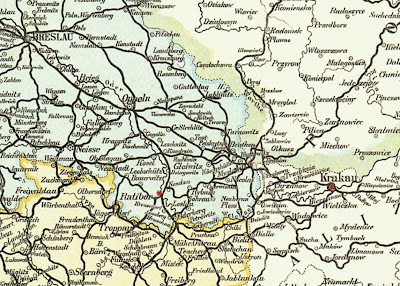

Ratibor, on the other hand, was a little farther away and the train fare may have been a bit more expensive.  Nevertheless, they would have safely avoided the Russian frontier by going to Ratibor.  Unfortunately, documentation does not exist and we will probably never know of their exact route.  Leipzig, however, was probably not an option since that city is quite a bit farther west than they were headed at that point.  It may be interesting to note that the Ratzlaff party may have considered themselves German or even Dutch.  In Russia, the Mennonites tended to cling to their German heritage; maintaining their German language and customs.  They did not acclimate themselves with their Russian, Polish or Ukrainian neighbors.  Once the Ratzlaff party crossed the border into Austria-Hungary and Germany, they may have felt somewhat secure since they were familiar with the language and culture.

Railway station at Mysowitz:


Railway station at Ratibor:

Border crossing out of Russia

Crossing the Russian/Austro-Hungarian border in the very early 20th century would have been a very difficult task.  To cross legally, the emigrant would need to be very patient while moving through the various steps.  He must have the proper paperwork and supporting documentation, he should probably have a ship ticket and/or a sponsor in the destination country.  He would have to be able to pass a medical examination and wait through tedious lines in very poor conditions.  Even if he passed through all these steps, he could be turned back at any point and be forced to return to his home.  A home that may or may not be waiting on him depending upon whether he sold his house and/or possessions.

If he chose to bypass the proper procedures and somehow illegally cross the border, he faced the danger of dealing with shady border smugglers who might do what they could to steal from or cheat the poor emigrant.  Border smugglers popped up in many border towns at the time.  Known as Agenten shvindlers or Geheime Agenten, these smugglers could be very dangerous to deal with.  Obviously these were people who made their living avoiding the law so their scruples were probably different from the emigrants who hired them.  For very high prices they would offer to assist emigrants over the border illegally, but this process ended badly for many, many emigrants.  Most smuggling was done at night.  Some smugglers would take the emigrant half-way, and then, under cover of darkness demand more money from the emigrant.  They might physically steal the emigrants’ possessions or lead them into a dangerous position physically in relation to armed border guards.  The emigrant was worried enough dealing with eluding official border guards but the transaction with the smuggler must have been almost as bad.

By 1893, inspection stations had been set up in many border towns to examine potential emigrants.  Some of these stations were maintained by the primary German shipping lines, Nord-Deutscher Lloyd and the Hamburg-America Line.  At the train station, the potential emigrants would be taken directly to the border station for examination.  Their luggage may have to stay behind at the depot and who can say what might happen to it there.  Conditions at the border stations were primitive and overcrowded.  If an emigrant passed the examination, he would have to wait in the station for the arrival of the train.  The wait could take several days and food and water were not necessarily provided by the station.  If the emigrant didn’t yet have a ship ticket, he may be able to purchase one at the border station.  Of course all the agents at the train station and border station would have been anxious to make extra money off the confused immigrants and tickets would be over-priced.

In 1907, the US Congress formed a special committee to investigate the European immigration process.  Called the Dillingham Commission, this report contains a lot of interesting information regarding immigration in the early 1900s: http://books.google.com/books?id=cmVE8ZNtDXAC&pg=PA97&lpg=PA97&dq=f+missler+bremen+agent+immigration&source=bl&ots=TS0QARLdhH&sig=LElIHHj8fvMQVXo3tDELlcw08YQ&hl=en&sa=X&ei=DMYmT5-cKMigtwf27cmgCw&ved=0CEUQ6AEwBQ#v=twopage&q&f=false

If Andreas had decided to navigate through the proper channels, he would have needed to acquire the necessary paperwork and pass through the examination processes at the border station, which could have been a very complicated and difficult process.  The examination itself probably wouldn’t have been a problem; the family moved through examinations later in Germany and apparently they all got through.  Andreas was probably happy to avoid the primitive, cramped conditions at the border station though.

The real problem for the Ratzlaffs regarding crossing the border legally may have been the fact that according to his internal passport, Andreas was due to return to the Forestry Service on January 1, 1909.  He would probably have had to show the internal passport at any Russian border stations and the fact that he still had duty pending may have been enough for him to have been turned back. 

As it stood, the Ratzlaffs hired smugglers to take them across the border.  As we saw previously, the Ratzlaff party would probably have wanted to detrain at Iwanie Puste to avoid the border station in Radziwilow.  In this case, they would have had about a 15 mile walk to the border and about 5 more miles to reach Brody, Austria-Hungary.  At Brody, they would have collected any luggage and moved onto a train bound for Lemberg (L’viv) and beyond.  The Brody train station:

Friday, April 27, 2012

Andreas Ratzlaff family emigration; crossing the border

This map clearly shows the border area between Radziwilow, Volhynia, Russia, and Brody, Austria-Hungary as it appeared when the Ratzlaffs left Russia in 1907.  The railroad tracks are the black line passing from top right to bottom left on this map.  The distance between Radziwilow and Brody by direct route on the road is a little less than 7 miles.


Marie (Ratzlaff) Penner in her memoirs indicates that the family paid 300 rubles for a Jewish guide to smuggle them safely across the border.  Marie says they hid in barns during the day and walked at night.  The children were warned to be quiet and make no noise walking through the dense woods.  Border guards had been bribed so the Jewish guides could take the baggage over the border on the road with a horse and wagon.  They must have walked a long time as Marie remembered being extremely fatigued by the time they made it across the border.  My Grandfather, Albert Ratzlaff, who was not born at this time yet, told that in the end the guides wound up stealing most of the family’s baggage.

The main border immigrant station was at Radziwilow, just outside the train station.  The plan the Ratzlaffs were obviously following was to escape across the border on foot.  For reasons I’ll discuss later, they didn’t want to go through the proper procedure of inspection and administration and pass through the Radziwilow border station legally. 

They would have wanted to detrain before they arrived in Radziwilow, so they would have got off at a previous station and walk from there.  In 1907, the first station to the east of Radzivilow was near Iwanie Puste, shown on this map toward the top right.  By 1920, another station had been built near Michailowka, but in 1907 Iwanie Puste would have been the closest the Ratzlaffs could have got to Radziwilow without actually entering that town by train.  The distance from Iwanie Puste to Radziwilow is about 14 miles, with an additional 7 miles to go to reach Brody.  That may be the route they took as Marie implies the walking journey over the border took a few nights to complete.  On a modern map, Radziwilow will be marked Radyvyliv and Iwanie Puste, Pustoivanne.  Here’s a picture of the border crossing in Radziwilow that the Ratzlaff’s avoided as it looked in 1905.


Andreas Ratzlaff family emigration; leaving Russia

The Andreas Ratzlaff family probably left Leeleva already in possession of their tickets to board the ship in Bremen, Germany.  Andreas would probably have purchased them from an agent, possibly in Ostrog.  Many emigrants purchased tickets from agents near their homes, well before they ever reached their port of departure.  With tickets in hand, it was much easier for these emigrants to pass border inspections and continue to move forward with their journey.  If they didn’t have tickets in hand, they stood a greater chance of being blocked at a border crossing.  This map shows Europe in the very early 1900s.  The Ratzlaffs’ starting point, Ostrog, is marked to the right with a green X.  They were bound for Bremen, Germany, which is underlined to the left.


Although Andreas probably already had the ship tickets, the family still needed to reach the German border before they would be safe.  Andreas planned to sneak illegally across the Russian border so doubtless the initial phases of the journey were highly stressful.  The Ratzlaff family travelled with Susanna’s parents and several of her sisters, as well as the Benjamin Unruh family.  The total party consisted of either 24 or 26 people.

Most likely the first place the party would have made for would have been Lemberg (L’viv), Austria-Hungary.  At the time, this was the largest, closest city outside the Russian Empire.  Since Andreas needed to sneak across the border, it would have been imperative to get out of the Russian Empire as soon as possible .  Lemberg was a very large city at the time and would have been an obvious destination; it was central eastern Europe's transportation hub connecting the central Slavic countries to the German Empire via rail.  Before they could reach Lemberg, though, they would need to cross the Russian/Austro-Hungarian border.  Radziwilow, Volhynia, was the nearest and most convenient border crossing to the Ostrog area.  On the other side of the border from Radziwilow, lay Brody, Austria-Hungary.  At Brody, the party could board a train for nearby Lemberg.  This map shows the route from Ostrog to Lemberg via Radziwilow and Brody.


After selling their belongings and packing what they would carry with them, Marie (Ratzlaff) Penner tells us the families left early one April morning while it was still dark, bound for the nearest train station.  The nearest station would have been either Kryvyn (Krevin, Krzywin) or Ozhenyn (Ozenin).  Ostrog itself didn’t have a train station; the tracks passed north and east of the town.  Ostrog was served by the stations at Ozhenyn to the north and Kryvyn to the east.  Kryvyn is 20 miles from Leeleva via Ostrog; Ozhenyn about 19 miles.  Today, Ozhenyn is the “official” Ostrog station.  It’s also possible that they would have gone to Mohylyany sation (20 miles away) or Badivka (Blodowka) station (17 miles away) via Vil’vivne (Welburne, Wielbowne), but I feel that’s less likely.  Based upon the fact that the Kryvyn station was marked so prominently by the author of the hand drawn Leeleva map (spelled “Krevin” on the map), I feel it’s entirely possible that Kryvyn was the station they used.  The Mennonites may have avoided Ozhenyn since many Muslims lived along the road from Ostrog to Ozhenyn.  This map from the very early 1900s shows the area pretty well.  Note that Leeleva, toward the bottom left, is marked Nikitska.


At the station, the family would have probably been able to board with a minimum of difficulty.  Andreas’ internal passport allowed the bearer travel inside the country.  From the boarding station to their destination near Radziwilow, the Ratzlaff party would have passed through Zdolbunow first, then Dubno, and then on to Radziwilow (Radziwillow), a distance of about 95 miles.  They probably would have detrained prior to Radziwilow where they would have prepared for the smuggle across the Russian/Austro-Hungarian border to Brody, Austro-Hungary.  Marie (Ratzlaff) Penner suggests they snuck into Czechoslovakia but that can’t be accurate as Czechoslovakia didn’t exist at the time.  This map shows the train route from Ostrog to Radziwilow.  The map is from a date later than 1907, by which time some borders had changed.  The map accurately shows the train route though: