Wednesday, May 2, 2012

Andreas Ratzlaff family emigration; train to Germany

In late 19th and early 20th century, the vast majority of European emigrants leaving the continent for America travelled through and departed from Germany.  Most of these travelled via the main German shipping lines of Nord-Deutscher Lloyd, based in Bremen, Germany, and the Hamburg-America Line, based in Hamburg, Germany.  By the early 20th century, quite a bit of infrastructure was in place to assist the immigrants on their trip. 

Immigrant stations, sponsored by the German shipping lines, were located at several locations along the German frontier.  At these stations, immigrants would be processed for travel and board trains bound first for Berlin, Germany, and then either Bremen or Hamburg.  These immigrant stations were positioned at strategic points along the frontier where immigrants from Russia, Poland, Austria-Hungary, the Baltic States, etc, could easily reach them.  Stations included locations at Bajorham, Tilsit, Eydtkuhnen, Insterburg and Prostki along the Baltic frontier; Ilowo, Posen, Ostrow and Soslowice along the Polish-Russian frontier; and Myslowitz, Ratibor and Leipzig along the Austro-Hungarian frontier.  The Ratzlaff Party, having successfully crossed the Russian – Austro-Hungarian border, would have made one of these immigrant stations their destination. 

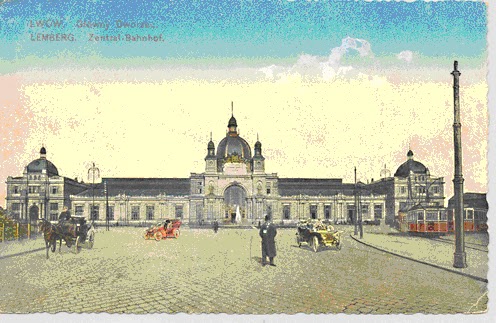
Arriving at Brody, Austria-Hungary, the party would have acquired train tickets to get to Lemberg (today know as L’viv or L’vov).  Lemberg was a very large city at the turn of the century.  The central railway depot was brand new in 1904 and would have seemed tremendously imposing to foreign immigrants:


After passing through Lemberg, the Ratzlaff party would have been bound for Krakow (Cracow) via Przemysl, Jaroslau, Rzeszow, Tarnow and Buchnia:


The railway station at Krakow:


At Krakow, the party would have needed to make a decision about which immigrant station they would use.  At that time, stations were positioned along the Austro-Hungarian – German frontier at Myslowitz (Myslowice) and Ratibor (Racibor), as well as Leipzig.  The station at Myslowitz would have been more direct; Myslowitz lay at the junction of the Russian – Austro-Hungarian – German border.  Since the party had been smuggled out of Russia, I can imagine they would have wanted to avoid contact with the Russian border at all costs.  If a Russian officer would have reviewed the Ratzlaffs’ travel documents, they may have been detained or made to return to Volhynia. 


Ratibor, on the other hand, was a little farther away and the train fare may have been a bit more expensive.  Nevertheless, they would have safely avoided the Russian frontier by going to Ratibor.  Unfortunately, documentation does not exist and we will probably never know of their exact route.  Leipzig, however, was probably not an option since that city is quite a bit farther west than they were headed at that point.  It may be interesting to note that the Ratzlaff party may have considered themselves German or even Dutch.  In Russia, the Mennonites tended to cling to their German heritage; maintaining their German language and customs.  They did not acclimate themselves with their Russian, Polish or Ukrainian neighbors.  Once the Ratzlaff party crossed the border into Austria-Hungary and Germany, they may have felt somewhat secure since they were familiar with the language and culture.

Railway station at Mysowitz:


Railway station at Ratibor:

Border crossing out of Russia

Crossing the Russian/Austro-Hungarian border in the very early 20th century would have been a very difficult task.  To cross legally, the emigrant would need to be very patient while moving through the various steps.  He must have the proper paperwork and supporting documentation, he should probably have a ship ticket and/or a sponsor in the destination country.  He would have to be able to pass a medical examination and wait through tedious lines in very poor conditions.  Even if he passed through all these steps, he could be turned back at any point and be forced to return to his home.  A home that may or may not be waiting on him depending upon whether he sold his house and/or possessions.

If he chose to bypass the proper procedures and somehow illegally cross the border, he faced the danger of dealing with shady border smugglers who might do what they could to steal from or cheat the poor emigrant.  Border smugglers popped up in many border towns at the time.  Known as Agenten shvindlers or Geheime Agenten, these smugglers could be very dangerous to deal with.  Obviously these were people who made their living avoiding the law so their scruples were probably different from the emigrants who hired them.  For very high prices they would offer to assist emigrants over the border illegally, but this process ended badly for many, many emigrants.  Most smuggling was done at night.  Some smugglers would take the emigrant half-way, and then, under cover of darkness demand more money from the emigrant.  They might physically steal the emigrants’ possessions or lead them into a dangerous position physically in relation to armed border guards.  The emigrant was worried enough dealing with eluding official border guards but the transaction with the smuggler must have been almost as bad.

By 1893, inspection stations had been set up in many border towns to examine potential emigrants.  Some of these stations were maintained by the primary German shipping lines, Nord-Deutscher Lloyd and the Hamburg-America Line.  At the train station, the potential emigrants would be taken directly to the border station for examination.  Their luggage may have to stay behind at the depot and who can say what might happen to it there.  Conditions at the border stations were primitive and overcrowded.  If an emigrant passed the examination, he would have to wait in the station for the arrival of the train.  The wait could take several days and food and water were not necessarily provided by the station.  If the emigrant didn’t yet have a ship ticket, he may be able to purchase one at the border station.  Of course all the agents at the train station and border station would have been anxious to make extra money off the confused immigrants and tickets would be over-priced.

In 1907, the US Congress formed a special committee to investigate the European immigration process.  Called the Dillingham Commission, this report contains a lot of interesting information regarding immigration in the early 1900s: http://books.google.com/books?id=cmVE8ZNtDXAC&pg=PA97&lpg=PA97&dq=f+missler+bremen+agent+immigration&source=bl&ots=TS0QARLdhH&sig=LElIHHj8fvMQVXo3tDELlcw08YQ&hl=en&sa=X&ei=DMYmT5-cKMigtwf27cmgCw&ved=0CEUQ6AEwBQ#v=twopage&q&f=false

If Andreas had decided to navigate through the proper channels, he would have needed to acquire the necessary paperwork and pass through the examination processes at the border station, which could have been a very complicated and difficult process.  The examination itself probably wouldn’t have been a problem; the family moved through examinations later in Germany and apparently they all got through.  Andreas was probably happy to avoid the primitive, cramped conditions at the border station though.

The real problem for the Ratzlaffs regarding crossing the border legally may have been the fact that according to his internal passport, Andreas was due to return to the Forestry Service on January 1, 1909.  He would probably have had to show the internal passport at any Russian border stations and the fact that he still had duty pending may have been enough for him to have been turned back. 

As it stood, the Ratzlaffs hired smugglers to take them across the border.  As we saw previously, the Ratzlaff party would probably have wanted to detrain at Iwanie Puste to avoid the border station in Radziwilow.  In this case, they would have had about a 15 mile walk to the border and about 5 more miles to reach Brody, Austria-Hungary.  At Brody, they would have collected any luggage and moved onto a train bound for Lemberg (L’viv) and beyond.  The Brody train station:

Friday, April 27, 2012

Andreas Ratzlaff family emigration; crossing the border

This map clearly shows the border area between Radziwilow, Volhynia, Russia, and Brody, Austria-Hungary as it appeared when the Ratzlaffs left Russia in 1907.  The railroad tracks are the black line passing from top right to bottom left on this map.  The distance between Radziwilow and Brody by direct route on the road is a little less than 7 miles.


Marie (Ratzlaff) Penner in her memoirs indicates that the family paid 300 rubles for a Jewish guide to smuggle them safely across the border.  Marie says they hid in barns during the day and walked at night.  The children were warned to be quiet and make no noise walking through the dense woods.  Border guards had been bribed so the Jewish guides could take the baggage over the border on the road with a horse and wagon.  They must have walked a long time as Marie remembered being extremely fatigued by the time they made it across the border.  My Grandfather, Albert Ratzlaff, who was not born at this time yet, told that in the end the guides wound up stealing most of the family’s baggage.

The main border immigrant station was at Radziwilow, just outside the train station.  The plan the Ratzlaffs were obviously following was to escape across the border on foot.  For reasons I’ll discuss later, they didn’t want to go through the proper procedure of inspection and administration and pass through the Radziwilow border station legally. 

They would have wanted to detrain before they arrived in Radziwilow, so they would have got off at a previous station and walk from there.  In 1907, the first station to the east of Radzivilow was near Iwanie Puste, shown on this map toward the top right.  By 1920, another station had been built near Michailowka, but in 1907 Iwanie Puste would have been the closest the Ratzlaffs could have got to Radziwilow without actually entering that town by train.  The distance from Iwanie Puste to Radziwilow is about 14 miles, with an additional 7 miles to go to reach Brody.  That may be the route they took as Marie implies the walking journey over the border took a few nights to complete.  On a modern map, Radziwilow will be marked Radyvyliv and Iwanie Puste, Pustoivanne.  Here’s a picture of the border crossing in Radziwilow that the Ratzlaff’s avoided as it looked in 1905.


Andreas Ratzlaff family emigration; leaving Russia

The Andreas Ratzlaff family probably left Leeleva already in possession of their tickets to board the ship in Bremen, Germany.  Andreas would probably have purchased them from an agent, possibly in Ostrog.  Many emigrants purchased tickets from agents near their homes, well before they ever reached their port of departure.  With tickets in hand, it was much easier for these emigrants to pass border inspections and continue to move forward with their journey.  If they didn’t have tickets in hand, they stood a greater chance of being blocked at a border crossing.  This map shows Europe in the very early 1900s.  The Ratzlaffs’ starting point, Ostrog, is marked to the right with a green X.  They were bound for Bremen, Germany, which is underlined to the left.


Although Andreas probably already had the ship tickets, the family still needed to reach the German border before they would be safe.  Andreas planned to sneak illegally across the Russian border so doubtless the initial phases of the journey were highly stressful.  The Ratzlaff family travelled with Susanna’s parents and several of her sisters, as well as the Benjamin Unruh family.  The total party consisted of either 24 or 26 people.

Most likely the first place the party would have made for would have been Lemberg (L’viv), Austria-Hungary.  At the time, this was the largest, closest city outside the Russian Empire.  Since Andreas needed to sneak across the border, it would have been imperative to get out of the Russian Empire as soon as possible .  Lemberg was a very large city at the time and would have been an obvious destination; it was central eastern Europe's transportation hub connecting the central Slavic countries to the German Empire via rail.  Before they could reach Lemberg, though, they would need to cross the Russian/Austro-Hungarian border.  Radziwilow, Volhynia, was the nearest and most convenient border crossing to the Ostrog area.  On the other side of the border from Radziwilow, lay Brody, Austria-Hungary.  At Brody, the party could board a train for nearby Lemberg.  This map shows the route from Ostrog to Lemberg via Radziwilow and Brody.


After selling their belongings and packing what they would carry with them, Marie (Ratzlaff) Penner tells us the families left early one April morning while it was still dark, bound for the nearest train station.  The nearest station would have been either Kryvyn (Krevin, Krzywin) or Ozhenyn (Ozenin).  Ostrog itself didn’t have a train station; the tracks passed north and east of the town.  Ostrog was served by the stations at Ozhenyn to the north and Kryvyn to the east.  Kryvyn is 20 miles from Leeleva via Ostrog; Ozhenyn about 19 miles.  Today, Ozhenyn is the “official” Ostrog station.  It’s also possible that they would have gone to Mohylyany sation (20 miles away) or Badivka (Blodowka) station (17 miles away) via Vil’vivne (Welburne, Wielbowne), but I feel that’s less likely.  Based upon the fact that the Kryvyn station was marked so prominently by the author of the hand drawn Leeleva map (spelled “Krevin” on the map), I feel it’s entirely possible that Kryvyn was the station they used.  The Mennonites may have avoided Ozhenyn since many Muslims lived along the road from Ostrog to Ozhenyn.  This map from the very early 1900s shows the area pretty well.  Note that Leeleva, toward the bottom left, is marked Nikitska.


At the station, the family would have probably been able to board with a minimum of difficulty.  Andreas’ internal passport allowed the bearer travel inside the country.  From the boarding station to their destination near Radziwilow, the Ratzlaff party would have passed through Zdolbunow first, then Dubno, and then on to Radziwilow (Radziwillow), a distance of about 95 miles.  They probably would have detrained prior to Radziwilow where they would have prepared for the smuggle across the Russian/Austro-Hungarian border to Brody, Austro-Hungary.  Marie (Ratzlaff) Penner suggests they snuck into Czechoslovakia but that can’t be accurate as Czechoslovakia didn’t exist at the time.  This map shows the train route from Ostrog to Radziwilow.  The map is from a date later than 1907, by which time some borders had changed.  The map accurately shows the train route though:

Andreas Ratzlaff Russian passport

On February 20, 1907, Andreas Ratzlaff was issued his internal Russian passport.  Although it was just an internal passport, Andreas carried it to America with him and it was kept by my Grandfather, Albert Ratzlaff.

Andreas would have applied for this passport at the police station in either Ostrog or Kuniv.  It’s interesting that he applied for this passport in February, 1907, when he knew that the family would be leaving the country in the upcoming months.  This internal passport would not have done him much good for the international journey.  He was probably just updating the document so that 1) he would be within the rules of the county at that period of time, and 2) so he and the family could travel legally to the Russian border. 

Within the pages of the passport, we read that Andreas’ Forestry Service duty was to resume in 1909.  In Andreas’ Forestry Service paperwork we saw that he was a member of the reserve brigade from 1895 and was given leave from service from March to August of 1905.  Did Andreas leave home periodically to serve in the forestry service?  I don’t know what his service status was in 1907 – his service duty must have been in order for him to have received the internal passport – but it’s clear from the document that he was due for return to the service in a few years, in 1909.

The first page of the passport simply states that the document indeed is a passport and that it was issued in Kynistsky Parish in the Ostrog District in Volyn Province on 20 February, 1907, to the peasant Andreas Yakovlev Ratslaf (Андреасъ Яковлевъ Рацлафъ).  The document cost 15 kopecks (apparently discounted from 25) and expires in 5 years.  Andreas’ patronymic name, Yakovlev, is used throughout this document.  In Russian culture a patronymic name is frequently used.  It’s simply the person’s father’s name followed by “olev” or “ovich”.  Thus Andreas’ patronymic name was his father’s with the proper suffix; Jacob-olev or Yakovlev.  The purple stamp at the bottom apparently indicates that Andreas was a reserve member of his lower rank (see item #7 perhaps?):


The next pages of the passport are data identifying Andreas:
1)   Name, Patronymic, Surname: Andreas Yakovlev Ratslaf
2)      Social Classification: Peasant
3)      Date of Birth or Age: 37 years
4)      Faith: Mennonite
5)      Occupation: Weaver
6)      Marital status: Married
7)      Military Service: Served as Mennonite worker in Forest Brigade.  Duty resumes as of 1 January 1909 (date may have been added later as the handwriting is different)
8)      Passport Issued on the Basis of the Following Documents: Census List #852
9)      Signature of Bearer:

Andreas Ratslaf

If the bearer of this document is illiterate let him make his mark here.

(Signature of government official or notary)


Page 4 lists Andreas’ family members:

10)  Dependants of the Bearer of this Document:
Wife Susanna aged 33
Son Jugen born 1 February 1903
Daughters Maria b 1897
Carolina b 1899
Ekaterina b 1902
Florentina b 1904
Susanna born 1906

Signed and stamped by parish official

Page 5 allows for changes in family status of the bearer or any of the above listed dependents.  No notations have been made here:


Pages 6 and 7 give explanations for the rules of residence and any travelling.  On page 7 is a small space for passport stamps.  Stamped in red across the page is the word "canceled".  I'm not sure what that means in this context; were items 67 and 70 canceled, or could that apply to the whole booklet?:


Page 8 to the end are spaces that would be stamped when the citizen paid his taxes.  The spaces in Andreas’ passport are blank indicating that between the time of issuance until the time the Ratzlaffs left the country, no taxes were paid:


Thursday, April 26, 2012

Emigration from Russia

Emigration from Russia in the early 20th century was not an easy task.  Europeans had been leaving their homelands for America since the 17th century.  The ease of train and ship travel had increased greatly and immigrant routes through Germany, aided by travel brokers, were well established by the 1900s.  Still, leaving one’s homeland in Russia and undertaking a journey of thousands of miles across Europe and the Atlantic Ocean to America was a monumental task. 

Marie (Ratzlaff) Penner indicates that her father, Andreas, considered moving his family to Argentina and that the adults sat up many nights by the light of the oil lamp debating how they would make their way out of Russia.  Many bureaucratic obstacles stood in their way not to mention the prohibitive total pricetag the journey would carry.  My father, Norman Ratzlaff, has told me in the past that members of the Lone Tree Holdeman Congregation near Moundridge, Kansas, assisted the family with their travel expenses.  I don’t have any was to confirm that suggestion, nor do I know how much assistance was needed, but it seems to be plausible.  Peter and Katarina Wedel are both buried in the Lone Tree cemetery and many of the Karolswalders joined the Lone Tree Congregation after reaching Kansas.  If help was needed, it makes sense that the Lone Tree Congregation would have been the first place the Ratzlaffs would have turned for help.  Perhaps for this reason, as well as the fact that his father, Jacob, and his other brothers and sisters already resided in Kansas, Andreas was persuaded to set Kansas as the family’s destination.

By the first decade of the 1900s, a complete immigrant network had spread throughout Russia, Eastern Europe, and Germany.  German shipping and rail lines had established routes and stations along the immigrant trail and agents of the shipping lines had offices throughout Europe.  Andreas Ratzlaff used Friedrich Missler as his agent for the journey.  Missler was based in Bremen, Germany, and was associated with the shipping line Norddeutscher Lloyd (North German Lloyd).  Missler was a well-established agent used by countless numbers of immigrants during this time period.  http://de.wikipedia.org/wiki/Friedrich_Missler
Associates of Missler’s agency distributed fliers on calendars and in newspapers throughout Eastern Europe and Western Russia and Andreas could have seen a flier something like this hanging in a public place somewhere in the Leeleva area.  This particular flyer is in Czech and was posted in Prague:


A master marketer, Missler provided his clients with canvas wallets in which to carry their travel documents.  Andreas used this wallet, emblazoned with Missler’s address, to carry the family’s paperwork:


Pictures of other wallets can be found on the internet in Polish or other Eastern European languages.  Andreas' wallet was in German just like this one. 
Today, many descendants of immigrants have made the mistake of thinking Missler was the name of the ship their ancestors took to America when in fact he was just the travel agent.

Missler would have taken care of the ship tickets for the Ratzlaffs.  The list price in 1912 for an adult ticket from Bremen, Germany, to Baltimore, Maryland, was about 75 rubles.  Maybe this would have been slightly lower in 1907.  Either way, this was the equivalent to about $750 today.  Children under a year cost about 5 rubles and children between 1 and 12 years old were half-price.  The passage by train from Russia to Bremen would have been an additional cost of about 15 rubles for an adult.  Further expenses would have included medical exams, food, accommodations, and other administrative fees.  The total price for an adult to travel to America would have been over 160 rubles (over $1600 in today’s dollars) (http://israel-stu.haifa.ac.il/staff/alroey/out-of-shtetl.pdf)  The Ratzlaffs numbered 8 people (Andreas, Susanna, Marie, Karoline, John, Katherine, Florentine and baby Susanna) and their total bill for the voyage would have been in the neighborhood of $7500 in today’s money.  This was certainly no small sum for a family from a very poor Volhynian village.

Andreas Ratzlaff had an internal Russian passport, but I doubt he had an international one that would have allowed him or his family to travel outside Russia.  19th and early 20th Century Russia required its citizens to carry internal passports as identification.  If a citizen was travelling in the country and was stopped without a passport, a fine would be levied (http://www.doukhobor.org/Passports.htm).  The purpose of an internal passport was for increased security.  The early 20th Century in Russia saw an increase in nationalism, economic class tension, and revolutionary thought development.  Overwhelmed bureaucratic systems, out of touch ruling class and gentry as well as political disasters such as the 1905 Russo-Japanese War, increased the severity of the general dissatisfaction of the populace and spurred the government to try to keep closer tabs on its citizens.  For more information regarding Russian international passports at the time, see http://books.google.com/books?id=cU0NAAAAYAAJ&lpg=PA56&ots=4aY4iF3vrO&dq=russian%20passport%201900&pg=PA55#v=onepage&q=russian%20passport%201900&f=false and http://books.google.com/books?id=gYt6Kf7DtwgC&lpg=PP1&pg=PA76#v=onepage&q&f=false.

Like I said, Andreas had an official internal Russian passport that allowed him to travel within Russia.  He may have had one since the days when he travelled to his forestry service camp in Kherson Province in the 1890s.  One of the first tasks the typical Russian peasant considering emigration would face would have been to visit a local police station and begin the paperwork to receive an international passport.  Andreas probably never began this process since he intended to escape across the Russian border illegally into Austro-Hungary.

Wednesday, April 25, 2012

Andreas and Susanna (Wedel) Ratzlaff family

Andreas and Susanna (Wedel) Ratzlaff were married on February 17, 1895, probably in Leeleva.  Both Andreas and Susanna had been baptized by Johann Schartner in 1889.  Schartner, who had been born in Karolswalde, moved to the Molotschna Colony sometime before 1860 (http://www.gameo.org/encyclopedia/contents/S33381.html).  After Tobias Unruh left with the bulk of the Karolswalde congregation in 1874, Schartner made frequent visits to Karolswalde to serve the congregation there. 

Andreas’ Forestry Service discharge papers indicate that he was discharged in December of 1894 to his hometown of Antonovka.  Abe J. Unruh indicates that the villages of Antonovka and Karolswalde were the 2 parish centers for the Mennonite villages.  Fuersenthal, Karolsberge and Jadwenin were associated with Karolswalde while Fuerstendorf (Leeleva) and Menziliski were associated with Antonovka.  When the Forestry Service discharged Andreas to Antonovka, it may have meant to the Parish of Antonovka because, as far as we know, neither the Jacob nor Andreas Ratzlaff families ever lived in the village of Antonovka.

Andreas and Susanna had the following eight children in Leeleva, six of whom survived:

            1)  Jacob (12/31/1895 – 01/18/1895)
            2)  Marie born 05/26/1897
            3)  Karoline born 01/30/1899
            4)  Adam (10/08/1900 – 08/28/1901)
            5)  Katherine born 01/27/1902
            6)  John born 02/14/1903
            7)  Florentine born 10/17/1904
            8)  Susanna born 02/26/1906

Four more boys would be born in America:

9)      Albert born 08/02/1908
10)  Abraham born 12/23/1909
11)  Jacob born 01/16/1912
12)  Isaac born 10/23/1914

The family lived in Leeleva, just down from the house of Susanna’s parents, Peter Jacob and Katarina Wedel.  The eldest daughter, Marie, has left us with recollections of her young years growing up in Leeleva and they were written down by her daughter Velma (Penner) Unruh.  Marie was 10 years old when the family left Leeleva for America, but she remembered a lot of details about Volhynia.

The villagers grew many fruits and vegetables including pumpkins, peas, parsnips, potatoes, corn and beans.  Wild strawberries and blueberries grew in the area, and there were also cherry and apple trees.  Storks flew in and built nests on the chimneys of the villages in the spring and wolves and wild hogs could be found in the forests.  The villagers kept chickens, geese and pigs; some had a cow but very few had a work horse.  The herd boy would come by in the morning to take the livestock to the pasture.  The land was hilly and many trees grew.  The Kuniv forest and the Ostrog forest were near the village on the north and west sides.

The houses in the village faced southwest and were arranged in an offset pattern.  If they were built in straight rows, if one caught fire, the fire could more easily spread to the next house.  The houses had thatched roofs and dirt floors, sprinkled with clean sand from the river.  The barns were attached to the houses and in the cold winter the livestock stayed in the barn area for longer periods of time.  The houses had “russian ovens”.  Villagers milked their cows and prepared cheese.  Many also wove flax into linen at night, using oil lanterns for light.

Winters were long and snow would pile deep.  The rivers would be solid with ice.  Most villagers wore wooden shoes but some had long Russian style boots.  At night the ice could be heard cracking on the rivers.  When all was quiet, the villagers could hear horse hoofbeats from the highway too.

In the area were many German Mennonites and Lutherans, but also Russians and Polish Eastern Orthodox.  The area also had a high Jewish population and once in a while Gypsy caravans could be seen.  In addition to German, some of the villagers spoke Russian or Ukrainian.  Andreas Ratzlaff could speak high German, low German, Russian and Yiddish. 

Weddings were held in the home of the bride who would wear a black dress.  The dress would be her good Sunday dress for years.  Homemade bread, borscht and noodle soup would be served. 

On Sundays, the service would be held in the minister’s home.  On weekdays, the village children would come to the home of the school teacher for classes.  Andreas served as a school teacher and the family would move their furniture out of the way every morning before the children arrived.  The Bible was the main textbook.  Abe J Unruh tells us that the school teacher was often times the herdsman too.  Andreas knew how to play the fiddle and the accordion and villagers would dance while Andreas played.  Andreas was also known as the village peacemaker and folks would come to him for mediation if there was a quarrel.

Everyone in the village had a special occupation.  There was a blacksmith, a shoemaker, a harness-maker, a carpenter, the minister, the schoolteacher, etc.  The land upon which the village was situated was much hillier than Kansas and the village lay at a more northerly latitude so the sun didn’t shine from so high in the sky.  The weather was much less windy and thunder and lightening storms were very rare. 

Unruh indicates in his book, The Helpless Poles, that after the bulk of the Mennonites left in 1874 the remaining colonists consolidated into a lesser number of villages.  Leeleva was the last remaining village.  By 1910 only a handful of families remained and they all lived in Leeleva (perhaps that is why Susanna Wedel’s family moved from Karolswalde to Leeleva probably sometime in the 1880s).  Early in the 1900s, along with Susanna’s parents the Wedels, and Susanna’s uncle’s family, the Benjamin Unruhs, Andreas and Susanna began making plans to leave Volhynia.