Monday, April 9, 2012

Jacob Ratzlaff emigration

The green Jacob Ratzlaff family history book mentioned earlier indicates that there were 21 people traveling together in the Ratzlaff party aboard the SS Polaria.  Since the Polaria’s manifest lists Andreas and Maria among the Jacob Ratzlaff family, I feel fairly confident saying these folks were all travelling together.  The manifest can be seen in its entirety here: http://collectionscanada.gc.ca/databases/passenger/001045-119.01-e.php?&sisn_id_nbr=3134&interval=20&&PHPSESSID=9spml0cqkh6h5jtp2mdde4jle4
It’s hard to say which other travelers were with the Ratzlaffs.  Immediately above Maria Ratzlaff’s entry are names that appear to be a Nightengale widow and her son.  I can’t tell what the first names are though.


The Jacob Ratzlaff family did have ties to Nightengale (Nachtigal) families in Russia, and there were many Nightengales living in the Karolswalde area.

According to the CMHS GRANDMA database, there was a married couple by the name of Andreas and Maria Ratzlaff who were both born in 1833, making them 60 years old in 1893.  This could very well be the Ratzlaff couple in question.  GRANDMA indicates that Andreas became deceased in 1892.  GRANDMA does indeed indicate that Maria travelled aboard the Polaria in 1893 so maybe the 1892 death date for Andreas is incorrect.  Otherwise, the information GRANDMA has for this couple is quite sketchy.  Maria’s maiden name was Janzen and the couple had eight children total.  They lived in Alexanderkrone and Fuerstenau in the Mennonite Molotschna Colony when their youngest children were born.  GRANDMA doesn’t list any further information for them.   The youngest two children, Johann and Heinrich, were born in1859 and 1861, respectively, in the Molotschna Colony.  Neither Johann nor Heinrich ever left Russia; both dying there in Mennonite Colonies years later.  No children are listed for Johann.  Heinrich, however, had several children.  Some of these are listed as having emigrated to the Fernheim, Paraguay, Mennonite Colony probably in the 1920s.  Andreas and Maria may have been the only members of this family to ever make it to the U.S.A.

Jacob Ratzlaff family emigration to USA

Mennonites settled in Russia in the 19th century for various reasons.  The St. Petersburg government gained control of South Russia during this time and wished that the fertile steppe be converted into valuable farmland.  In Volhynia, the Russian serfs were being freed and the landowners needed knowledgeable farmers to work the land.  Many Germans, including Mennonites, Lutherans and Baptists, were invited into Russia because of their acumen for working the soil.  Some, like the Mennonites in South Russia, were granted special privileges excusing them from military duties or exempting them from taxes.  By the mid-century mark, Ukraine was dotted with German colonies; farmers or cottage industrialists who did not assimilate with the native Ukrainians and Russians.  As time wore on and the nationalistic spirit grew, the Russian government began to desire that the Germans living in their midst become more “Russian” in culture so it instigated changes in its former policies that were favorable to the German colonists.  (http://en.wikipedia.org/wiki/History_of_Germans_in_Russia_and_the_Soviet_Union)

Mennonites in Volhynia and South Russia greatly valued their German heritage and had no desire to assimilate with the native Ukrainians or Russians.  Furthermore, their religion forbad them military service, so they began to leave Ukraine.  The mass exodus of Mennonites began in 1874 as they began to find new homes in the U.S.A., Canada, and South America. (http://www.gameo.org/encyclopedia/contents/U568.html)

The Jacob Ratzlaff family also began to look into leaving Volhynia.  In 1893 most of the family packed up and left, bound for Marion County, Kansas.  A generous resident of Marion County, Bernard Jantz, paid the travelling fare for the Ratzlaffs.  The travelling party consisted of 21 people and they boarded the SS Polaria, bound for Montreal, Canada.  The SS Polaria was a ship of the Hamburg-America Line and departed Hamburg, Germany, on June 10, 1893.  After a brief stop at Antwerp, Belgium, on June 14, 1893 the ship embarked on its cross-Atlantic voyage and reached Montreal, Canada on June 27th.  (http://www.norwayheritage.com/p_shiplist.asp?co=haaml)

Members of the Jacob Ratzlaff family who made the voyage were:
     Jacob and Anna,
     Henry (Heinrich), wife Katherine and their children Tobias and Karolina,
     Bernard and his wife Marie,
     Adam,
     Lena (Helene),
     John (Johann).

Jacob and Anna's other two children, Eva and Andreas, both stayed in Russia at this time.  They both would travel to the U.S.A with their families at later dates.

Bernard and Maria’s names appear on the first page of the manifest of the SS Polaria where they are listed as farmer and wife:


The names of the rest of the Ratzlaff party appear on the second page:


Joining the Jacob Ratzlaff family on the voyage was an Andreas Ratzlaff (note that this is NOT Andreas Ratzlaff, the son of Jacob Ratzlaff) and his wife Maria.  The SS Polaria manifest gives Andreas and Maria’s ages as 60 at the time of the voyage in 1893.

Friday, April 6, 2012

The Green Ratzlaff book

In 1958 the descendents of Jacob Ratzlaff produced a genealogy book that listed a short history of Jacob and his children.  The book is a small, light green, hardback volume, entitled History of Grandfather Jacob J Ratzlaff And Descendants; 1958.  Unfortunately it lacks any publication or production information so I am unsure of where it came from or who wrote it. 


The book is a very important resource as it lists Jacob’s children and such details as birth places and some immigration information.  However, two key pieces of information appear to be dubious.  In the book, Jacob’s middle initial is listed as “J”.  In multiple U.S. Census listings, Jacob’s middle initial is listed as “H”.  Furthermore, his father’s name, as can be seen from the Tobias Unruh baptism records, was Heinrich.  The common practice at the time was for a son’s middle name to be his father’s first name.  Therefore Jacob’s middle initial in all likelihood was “H”.  Also, the book lists Holland as the place of Jacob’s birth in 1842 and that’s probably not correct.  The California Mennonite Historical Society (CMHS) has produced the GRANDMA database which lists over a million low-german Mennonites.  The names are taken from a huge number of primary sources which have been used to create family trees (http://www.grandmaonline.org/gw-asp-2/login.asp).  CMHS researchers have found that Jacob’s father, Heinrich, was probably a resident of Karolswalde, therefore making it unlikely that Jacob was born in Holland.

Jacob Ratzlaff, (8/12/1842- 12/21/1926).
Married Anna Foth (05/24/1842-04/08/1912) in 1862.
The family emigrated in 1893 to Durham or Moundridge, Kansas from Volyhnia (probably Menziliski).

Children:
Henry (1863-1916)
(born Zabara, married 1887 to Mrs. Katherine (Base) Unruh (b. 06/30/1860), daughter of Benjamin and Anna ((Nightengale) Base)  emigrated 1893 with father Jacob  (spelled his surname “Ratzloff”)
Eva (1864-1949)
(born Zabara, Volhynia, married John Nightengale (d. 1899) emigrated 08/26/1909, landed in Galveston,TX, bound for Durham, KS)
Andreas (1869-1934) (wife, Susanna Wedel)
(born Leeleva, emigrated 1907, arrived at Hillsboro, KS, 05/29/1907)
Bernard (1871-1952)
(born Menziliski, married Marie Schultz, daughter of Cornelius and Leona (Jantz) Schultz, 1892)
            Adam (1881-1950) (born Volyhnia)
            Lena (1883-1934) (born Volyhnia)
            John (1890-1954) (born Volyhnia)

Also born to Jacob and Anna were 4 children who passed away in childhood.  3 babies died in infancy and another daughter, Elizabeth, passed away at the age of 15 years.  Elizabeth must have been born prior to 1878 since she had already passed away by the year 1893 when the family emigrated to USA.

Karolswalde Mennonite villages, Volhynia

The first place I can positively locate my Ratzlaff ancestors is in Volhynia, Russia.  Mennonites began settling in Volhynia in the late 1700s.  The largest Mennonite settlement in Volhynia was centered near Ostrog in Karolswalde.  Karolswalde was settled in the very early 1800s (http://home.arcor.de/pulin/karlswalde/tips.htm).  Villages associated with Karolswalde in the Ostrog area included Antonovka, Jadwanin, Karolsberg, Fuerstendorf, Fuerstenthal, as well as several others (http://www.gameo.org/encyclopedia/contents/K3760.html/?).
Karolswalde (also known as Karlswalde and Holendry Slobodkie), as well as several of the other villages, can be seen on this map from the 1800s.  They are marked “Col” because they were German colonies.  Fuerstendorf (Leeleva, Lesna) is marked as Nikitskaya.


Tobias Unruh (http://www.gameo.org/encyclopedia/contents/U57983.html/?searchterm), the elder of the Karolswalde villages during the mid-1800s, also served as elder for the village of Michalin near Berdichev, as well as for the villages of Dossidorf (Dosildorf, Zabara) and Waldheim (Waltajem, Solianka), northeast of Slawuta.  This map from the late 1800s shows the relationship between Dosildorf (upper right hand corner) and Karolswalde (circled at left).  The distance from Dosildorf to Karolswalde is just under 40 miles in a straight line.


Unruh kept records of those who he baptized and my great great grandfather, Jacob, appears among those records.  Jacob was baptized, along with several others, in Zabara in 1862.  Unruh’s entry lists Jacob as the son of Heinrich:

Die  Taufe in Dossidorf, welche in die Gemeine zu Antonowke gehoeren
1.  Jacob Jacobs Sohn                          Koehn                    in Dossidorf         
2.  Jacob Heinrichs Sohn                     Schmidt                 in Dossidorf
3.  Jacob Heinrichs Sohn                     Ratzlaff                  in Dossidorf
                                Die Jungfrauen:
1.  Eva Heinrichs Tochter                   Schmidten              in Dossidorf
2.  Anna Heinrichs Tochter                Koehnen                in Dossidorf
3.  Helena Heinrichs Tochter              Schmidten             in Dossidorf
4.  Anna Heinrichs Tochter                Koehnen                in Dossidorf
Diese hier auf diese Seite aufgeschriebene 3 maennliche und 4 weibliche Seelen sind auf ihrem Verlangen durch dem heiligen Worte Gottes und dem Befehle Jesu Christi im Beisein viele Zeugen getaufet und durch eine Handaufnehmung als Glieder in die mennoniten Gemeine zu Dossidorf am 21.ten Junius Neuenstyls 186  auf- und  angenommen worden. Als nehmlich vom Aeltester Tobias Unruh zu Karolswalde.

Przechowka Mennonites move into the Netzebruch

For various reasons, Mennonites began to leave Prussia by the mid-1700s.  In 1765, several families from the Przechowka congregation moved to the Netzebruch area near Driesen (Drezhdenko in Polish) which was in the Neumark area of Brandenburg.  These families founded the villages of Neu-Dessau, Franzthal and Brenkenhoffswalde.  http://www.gameo.org/encyclopedia/contents/N478.html
Central Eastern Europe, 1782:


In 1791, other Przechowka Mennonites settled near Machnowka, just south of Berdichev, in Volhynian Russia.  http://www.gameo.org/encyclopedia/contents/M5000.html/?searchterm=volhynia.
By 1819, the Przechowka Mennonites began travelling to the Molotschna Mennonite Colony in South Russia and by 1830 the Przechowka congregation in Prussia was mostly extinct.  Przechowka was the mother congregation of the Alexanderwohl and Gnadenfeld villages of the Molotschna Colony.  http://www.gameo.org/encyclopedia/contents/A44239.html
Ukraine in the mid 1800s:


Thursday, April 5, 2012

Prussian Mennonites near Przechowka

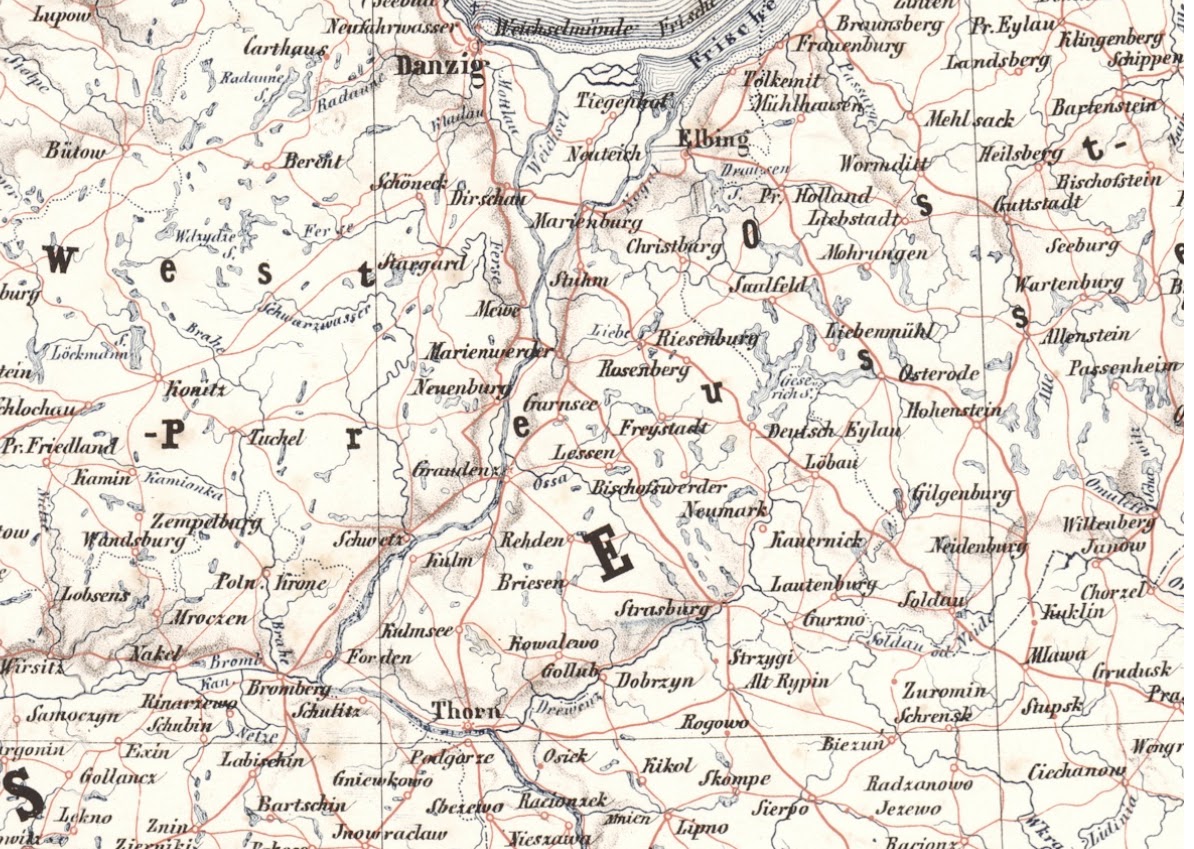
Schwetz (Sciewie), Poland, lies about 75 miles south of Danzig (Gdansk), on the northwest bank of the Vistula River.  In the 17th and 18th centuries, Mennonite villages flourished in the Vistula delta area.  Many congregations could be found surrounding Gdansk (Danzig), Elbing, Malbork (Marienberg), and Stuhm, and even as far south as Schwetz.  Later, Mennonites colonized even farther up the Vistula River, inhabiting villages around Gabin (Gombin) and Warsaw.  http://www.gameo.org/encyclopedia/contents/prussia/?searchterm=prussia.  This is how the area looked in the early 1800s:


According to the Przechowka Churchbook, Ratzlaffs lived in the villages of Przechowka (Wintersdorf in German), Bekieszyce (Beckersitz), Jeziorken and Konopat (among others).  Here’s a view of the area from a Polish map dated 1879:


This map, also from the late 1800s, shows Jeziorken (upper left) in relation to Wintersdorf (Przechowka) and Konopath:


Traces of the Mennonite villages can still be seen today on satellite images.  The Polish paper packaging company Mondi Packaging Sciewie, SA, occupies area immediately to the north of Przechowka.  Konopat still exists.  http://wikimapia.org/#lat=53.3827652&lon=18.3940315&z=14&l=0&m=b

Wednesday, April 4, 2012

The first Ratzlaff

Mennonites began settling in the Schwetz (modern-day Polish = Swiecie) area perhaps as early as the mid 16th century.  By the mid 17th, Przechowka was an established Mennonite congregation affiliated with the Groningen Old Flemish Societeit, the most conservative branch of Mennonites (http://www.gameo.org/encyclopedia/contents/P780.html/?searchterm=przechowka) in West Prussia.

The Mennonite congregation was well-established and we can see from the church records that many Ratzlaff families were members.  According to the Przechowka Churchbook, the first Ratzlaff was a soldier in the Swedish army who laid down his sword to join the Mennonite Church.  As the Prussian government forbad conversions to the Mennonite faith, Ratzlaff was forced to travel to Holland to be baptized into the Church.  Upon his return he joined the Przechowka congregation.  In the Przechowka Churchbook, we can see that his son, Hans, was born about 1610.  Hans had five sons, and from there the Ratzlaffs quickly became one of the most numerous families of the congregation.

The claims the Przechowka Churchbook makes to the first Ratzlaff being a Swedish soldier are entirely plausible as the Swedish Army was indeed operating in the Vistula area in the first quarter of the 17th century.  The Swedish-Polish War raged from 1600 – 1629 and the Swedish King, Gustavus Adolphus, led his Swedish troops into the areas around the Vistula: Pomerania, Mecklenburg, and East and West Prussia.  The Swedish troops are well-documented as having moved through the Prussian Grosswerder and Kleinwerder which were inhabited by many Mennonites at the time.  Cities and villages that were affected include Danzig (Gdansk), Elbing, Pilawa (Pillau), Gniew, Nowy and Brodnica (among many, many others).  Mennonite congregations existed in or near all these locations.

Our first Ratzlaff ancestor was impressed with the simple folk living along the Vistula.  At some point during the military campaigns in the early 1600s, he decided to drop his sword and join the Mennonite Church and settle in the village of Przechowka.