Working with Glenn Penner, I was recently fortunate enough to find Russian census information among the collections of the Mormon Family Search Library. Combined onto 4 rolls of film were scans of the 1816 Revision Lists (Ревізькі казки) for Ostrog and Kremenets Counties. I had no expectations viewing the films for the first time, but quickly stumbled upon the lists for the Village of Antonovka.
We are currently working to properly translate these lists, but it appears as if 22 families are listed, all identified as Mennonites, with an additional 7 families in 2 supplemental lists. Typical Przechowka family names are listed: Nachtigal, Buller, Becker, Ratzlaff, Jantz, Koehn, Richert, Schmidt, Wedel, Unruh, Voth. After efforts to properly translate these lists are complete, final drafts will be posted to mennonitegenealogy.com.
Unfortunately, after searching and searching, I have been unable to identify the lists for the Village of Karolswalde (Sloboda Holendry) on the Mormon films.
4 Ratzlaffs are listed living in Antonovka. 3 brothers; Peter, Heinrich, and Andreas (All sons of Bernard Ratzlaff of Jeziorken), as well as Peter Ratzlaff, whose father's name was also Peter Ratzlaff.
Of particular interest to me is Heinrich Ratzlaff, son of Bernard Ratzlaff. Heinrich is listed with his wife, Teresa, along with several children. One of these children, named Heinrich, was 3/4 of a year old at the time of the census, 1816 (possibly in June of that year). I believe this Heinrich may very well be my great great great grandfather, the father of Jacob Ratzlaff (b1842).
To confirm the relationship of Heinrich (b c1815) and Jacob (b1842), it would be necessary to see another census list that would list this Heinrich and his sons. Jewish researchers at JewishGen.org have indicated that the 1850 and 1858 Revision Lists are housed at the State Historical and Cultural Museum in Ostrog. And, as luck would have it, I have just potentially made a contact with a professor at the Ostrog Academy who may be willing to contact the director of the museum regarding potential copies of the Revision Lists. With a little more luck, I may be fortunate enough to get information from these Revision Lists and definitively link my Ratzlaff Family with the Ratzlaffs of Przechowka.
Monday, November 24, 2014

Wednesday, June 11, 2014
Virtual Tours and 360 Degree Views
Here are a few links to some sites that, utilizing new photography technology, can show us some of the sights around Ostrog without leaving our homes.
Click here for a virtual tour of the Town of Ostrog. Go inside the castle, museums, and academy.
Click here for 360 degree view of the forest near Kryvyn, and here for an amazing 360 view of the interior of the Holy Trinity Monastery in Mezhyrich (be sure to look up!).
Click here for a virtual tour of the Town of Ostrog. Go inside the castle, museums, and academy.
Click here for 360 degree view of the forest near Kryvyn, and here for an amazing 360 view of the interior of the Holy Trinity Monastery in Mezhyrich (be sure to look up!).
Saturday, May 10, 2014
Thomas Arthur Ratzlaff; Navy SEAL
I was just alerted to the fact that one of my 3rd cousins, Thomas Arthur Ratzlaff, was a Navy SEAL. Tommy was an operative of famed SEAL Team 6 which has been particularly active in Middle Eastern theaters these past several years.
Tommy was a great grandson of Adam J Ratzlaff, younger brother of my great grandfather Andreas J Ratzlaff. His grandfather Arthur Ratzlaff was a cousin to my grandfather Albert Ratzlaff. Tommy was born in 1976 in Arkansas and unfortunately met his end in 2011 in Afghanistan. A Time Magazine article about his death can be found here.
Thanks to Dennis Quiring for alerting me to my relationship with Tommy. I'm honored to have a hero like him in the family. Rest in peace, Tommy, and thank you for your sacrifice.
Thursday, December 12, 2013
Ostrog Castle Virtual Tour
An amazing virtual tour
of the Ostrog Castle Museum has been posted at:
The museum is housed in
the Вежа мурована (Murovena Tower), the southeast tower of the castle.
While this castle had
nothing to do with my ancestors' daily lives, it does show a lot about
Volhynian historical culture. The castle stood largely in ruins in the
19th Century, but was still a prominent landmark in the Ostrog area.
The Leeleva Mennonite Church identified its home village as "Lilewa
bei Ostrog" (Leeleva by Ostrog), so clearly in their minds they were tied
to Ostrog.
It's important not to
view our family history as having happened in a vacuum. To fully
understand our ancestors' lives, one has to have a handle on the local culture
- politically, socially and historically.
Monday, September 23, 2013
The Location of Leeleva
What about the fact that the Jake Unruh Leeleva map doesn’t seem
to correspond to today’s geography of the area south of Ostrog? To my knowledge, there are no maps that mark
a village as Leeleva directly south of Ostrog.
How then do we reach a conclusion regarding which village was the
Leeleva of our ancestors?
In the early German Mennonite sources, the village later
known as Leeleva was called Fürstendorf (Fuerstendorf). Abe J Unruh in his book The Helpless Poles,
as well as Mennonite Elder Tobias Unruh in his baptism records, refers to a German
Mennonite village by the name of Fürstendorf.
Jake Unruh, the author of the Leeleva map used frequently in this blog
says that Fürstendorf was the old name of the village, and that by about the
time of the turn of the century, the village was called Leeleva (this can
probably be attributed to the Empire’s “Russification” policy during the latter
half of the 19th Century. The
German name Fürstendorf undoubtedly had to be done away with) . In the Green Ratzlaff Book, the village is
referred to as Lilewa (in German, that “W” makes a “V” sound, so the
pronunciation of Leeleva and Lilewa would be very similar). Finally, in his 1905 survey of Mennonite
villages, (Statistik der Mennonitengemeinden in Russland Ende 1905 [Anhang zum
Mennonitischen Jahrbuche 1904/05], Gnadenfeld: Dirks, 1905: 39) Heinrich Dirks
asserts that the name of the village is Lileva, and that the ministers were
Johann Jantz, Johann Nachtigal, and Johann Dekkert. In a document possibly dated 1893 and signed
by Johann Böhse (Boese) attesting to the fact that the resident Benjamin Unruh
Family were Mennonites, Böhse names the village Lilewa and accompanies it with
“bei Ostrog” to note the village’s geographic proximity to the town of
Ostrog.
After the Mennonites left the area, Lutherans came to
populate the village (in fact, some Lutherans lived there already by the late
1900s). Metrical Books kept by the
Lutheran bishop in Rovno list the name as Furstindorf and Furstendorf. I am also in possession of a map of the
village dated 1935-1936 when the village was populated by Lutheran Germans which
names the village as Lesnoe.
I’ve consulted several experts with whom I am acquainted,
asking them regarding the location of the village of Fürstendorf. Luckily, we have many folks who are experts
in this area; there were many German colonists in Volhynia in the 19th
and early 20th Centuries.
Mennonites were among the first to come to the area, but Lutherans and
Baptists followed shortly behind.
Therefore we can look at not only Mennonite records to determine the
location of Fürstendorf/Leeleva, but also Lutheran and Baptist records as well.
Mennonite sources indicate that the village that was named Fürstendorf
was just a couple miles southwest of Jadwinin and maybe a mile more southeast
of Antonovka. This would seem today to
indicate the village of Lisna (Lesna).
This is a comparison of a modern satellite view versus the Ostog area
from the Mennonite Atlas. Note that
Jadwinin is known today as Novosilka.

Don Miller is a descendant of German Baptists who lived in
the area (Don’s ancestors actually lived in the village next door to the
village in which my Ratzlaffs lived for a short period of time to the northeast
of the Leeleva area named Zabara. Many
of our group of Mennonites lived in Zabara/Dosildorf in the 1850s and
1860s. My great grandfather Jacob
Ratzlaff was baptized there by Elder Tobias Unruh). Don is distinguished scholar regarding the
history of the Germans in Volhynia and annually leads tours to the area. He’s been down the road through Lisna many
times. He assures me that Lisna is
indeed our Fürstendorf/Leeleva.
Don Miller also referred me to a scholar named Jerry Frank,
an archivist with the Society for German Genealogy in Eastern Europe
(SGGEE). Mr. Frank, says Don Miller, is
the true expert dealing with Volhynian geography. I’ve emailed Mr. Frank and he also indicates
that Fürstendorf/Leeleva can certainly be found on maps today marked as Lisna.
In other places, Fürstendorf/Leeleva can be found as Lesnaya
or Lessnaja, a name somewhat similar to Leeleva. Soviet maps from the 1940s indicate this name,
and this Lesnaya is indeed the village that is today known as Lisna. References to Lesnaya as Fürstendorf can be
found at the website of the “Germans from Russia Heritage Society”, the “Black
Sea German Research” website, as well as the German website Wolhynien.de. Finally, many old German, Polish and Austrian
maps of the area mark the German villages in the area as colonies. For instance, Karolswalde, Antonovka and
Jadwinine are all usually preceded by “COL” or “KOL” to denote the fact that
the village was a German colony. In
these instances, whether the village is named Lesnaya, Fürstendorf or even
Nikitska, the village which corresponds to today’s Lisna is usually marked as a
colony. For instance, this Polish map
from the 1920s:

All the experts seem to agree, then, that today’s Lisna was
indeed the Leeleva Village of my ancestors.
I still have questions as to why the Jake Unruh map of Leeleva doesn’t
more closely approximate the geography of the village of Lisna village of Lisna

Jake Unruh was a very credible authority to draw the map of
Leeleva. He left Volhynia in 1907 as a
teenager but had been the unofficial village errand boy. When an errand or message needed to be
communicated to one of the other villages, Jake was the boy from Leeleva to
physically do the job by running to the other village. This would certainly give Jake intimate
knowledge of the geography of the area.
Even though the map wasn’t drawn until the 1970s, Jake probably kept
that information stored somewhere down through the years. But Jake probably didn’t have the luxury we
have today of looking at a map of the area when he actually lived there. Even if he was very good with directions, a
hilly, curvy road could have thrown his sense of direction or distance off
somewhat. Whatever the case, Jake’s map
is a priceless resource to our family history and I’m sure no one could have
drawn a better representation of the area.
Could the 1906 Volhynian census give us a clue? Could there have been a different village
named Leeleva? The 1906 census lists a
village named Lesnaya (Лѣсня) as well as Leleva (Лелева). Could this be a clue? Could there have been 2 villages by these
very similar names both within Kunev volost?
Or could this have simply been a clerical error by the census-takers
(for instance, the village of Balyary was simply omitted from the census;
perhaps one of these villages should represent Balyary?). More research needs to be done regarding this
issue.
Sunday, September 22, 2013
Unruh Family Reunion, 2013
I would like to thank the Benjamin Unruh Family for graciously welcoming me to their family reunion which took place a couple weeks ago in Halstead, KS. I found out the reunion was to take place, contacted a couple folks who were hosting, and they very warmly invited me to attend.
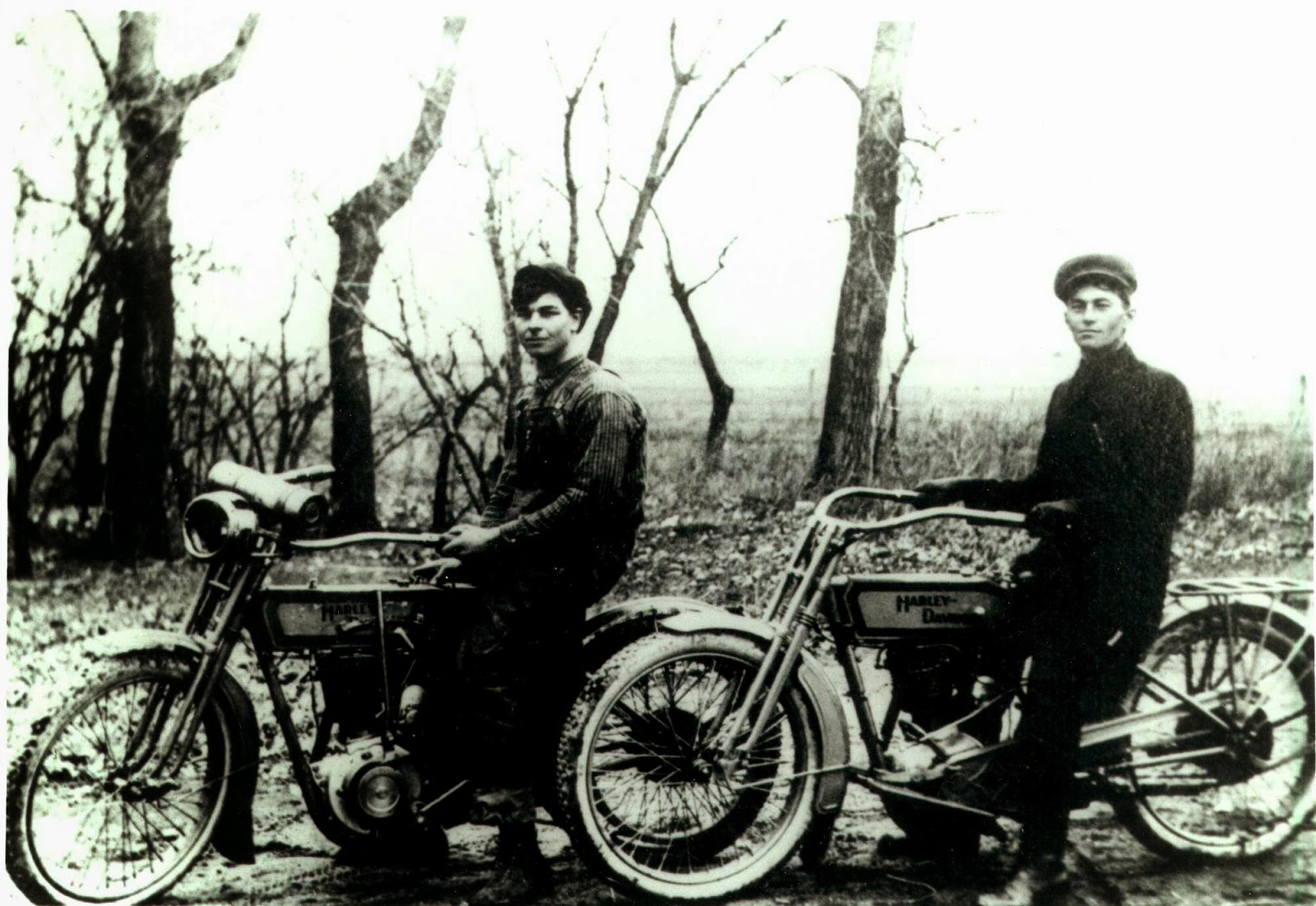
This Benjamin Unruh was the head of the family which accompanied my Ratzlaff and Wedel families to USA in 1907. Benjamin was actually related to the Wedel family too, so all 3 of these families were inter-related. I'm assuming that Benjamin was also a good friend of my great-grandfather Andreas' oldest brother Henry J. Ratzloff since they were both born in the same year. This photo, on display at the Unruh reunion, and given to me by my 3rd cousin Gordon Ratzloff, shows Henry Ratzloff's son, Jonas, along with Benjamin Unruh's oldest son Jake, on their motorcycles in 1913 (that's Jonas on the left and Jake on the right):

A few of the folks at the Unruh reunion had recently been to the Ostrog area in Ukraine and could attest to the fact that the inhabitants nowdays are poor and the land seems to be rather unproductive. I thoroughly enjoyed looking at their photos and hearing about their trip. Some German houses remain here and there in the area and an old-timer or two seem to remember some German names in the villages.
One of the grand-daughters of Jake Unruh (son of Benjamin Unruh) also had a German document which, after translating, was revealed to be a certificate attesting to the fact that Benjamin Unruh and his family were indeed Mennonites. The document is signed by the village minister, Johann Boese, who names the village as "Lilewa bei Ostrog' and the document was even stamped with the church's seal!

This Jake Unruh was also the man who penned the Leeleva map that is of such value today:

Although I wasn't directly related to the Unruhs at this reunion, I was probably related to everyone in the room in some way. After a bit of research, I found that I shared 3 sets of great-great-great grandparents with a few of the folks - I believe that makes me 4th cousins with them, 3 different ways! The Mennonites who lived in Leeleva in the early 20th Century were probably more like one big extended family and I'm sure my Ratzlaff ancestors would be happy to know that I attended the Unruh's reunion. Thanks again for welcoming me!
This Benjamin Unruh was the head of the family which accompanied my Ratzlaff and Wedel families to USA in 1907. Benjamin was actually related to the Wedel family too, so all 3 of these families were inter-related. I'm assuming that Benjamin was also a good friend of my great-grandfather Andreas' oldest brother Henry J. Ratzloff since they were both born in the same year. This photo, on display at the Unruh reunion, and given to me by my 3rd cousin Gordon Ratzloff, shows Henry Ratzloff's son, Jonas, along with Benjamin Unruh's oldest son Jake, on their motorcycles in 1913 (that's Jonas on the left and Jake on the right):
A few of the folks at the Unruh reunion had recently been to the Ostrog area in Ukraine and could attest to the fact that the inhabitants nowdays are poor and the land seems to be rather unproductive. I thoroughly enjoyed looking at their photos and hearing about their trip. Some German houses remain here and there in the area and an old-timer or two seem to remember some German names in the villages.
One of the grand-daughters of Jake Unruh (son of Benjamin Unruh) also had a German document which, after translating, was revealed to be a certificate attesting to the fact that Benjamin Unruh and his family were indeed Mennonites. The document is signed by the village minister, Johann Boese, who names the village as "Lilewa bei Ostrog' and the document was even stamped with the church's seal!

This Jake Unruh was also the man who penned the Leeleva map that is of such value today:

Although I wasn't directly related to the Unruhs at this reunion, I was probably related to everyone in the room in some way. After a bit of research, I found that I shared 3 sets of great-great-great grandparents with a few of the folks - I believe that makes me 4th cousins with them, 3 different ways! The Mennonites who lived in Leeleva in the early 20th Century were probably more like one big extended family and I'm sure my Ratzlaff ancestors would be happy to know that I attended the Unruh's reunion. Thanks again for welcoming me!
Friday, September 6, 2013
Cousin Gordon's blog; Leeleva Village Facebook page
Please check out Gordon Ratzloff's blog (Gordon is my 3rd cousin) at http://ceilingunlimited.com/fammail/
In the upcoming months we will have an interactive map of the village of Leeleva posted at this site where anyone can go to learn more about the elements of Jake Unruh's map of the village.
I've also started a Leeleva Village page on Facebook. It would be wonderful to create a virtual community where people could share family stories. If your ancestors lived in Leeleva (also known as Lisna, Lesna, Lebwa, Lesnaya, Lesnaja, Fuerstendorf, Fürstendorf, or Nikitskaya, please friend us (search for Leeleva Village Facebook to find the page).

Subscribe to:
Posts (Atom)