Friday, April 13, 2012

Jacob Ratzlaff family travels to USA

The Jacob Ratzlaff family left Russia in 1893 bound for the U.S.A.  Many of the Mennonites in the Karolswalde villages, including elder Tobias Unruh, had left for America in 1874.  The Mennonites from Volhynia settled mainly in Hutchinson and Turner Counties, South Dakota and Marion and Harvey Counties, Kansas (http://www.gameo.org/encyclopedia/contents/volhynia_ukraine/?searchterm=volhynia).  Perhaps because the Ratzlaffs' traveling fare was donated by Bernard Jantz of Durham, KS, the family were bound for Kansas.

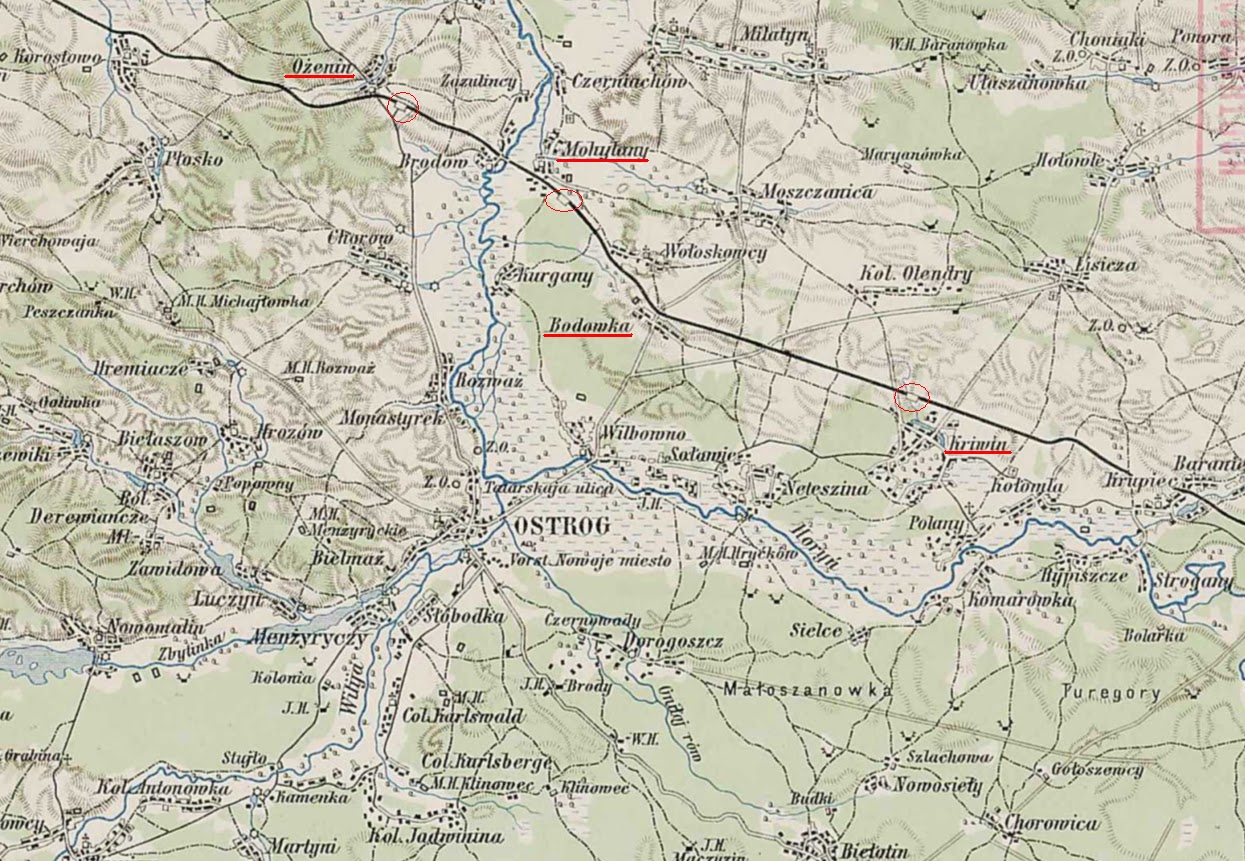
At this point I don’t know much about the Ratzlaffs' voyage from Volhynia to America.  There were train stations near Ostrog; at Kriwin, near Wilbowno at Badowka and Mohylany, and at Ozenin.  These locations are all north and east of Ostrog. 


In the 1890s, they probably would have crossed the border into Austria-Hungary near Brody. 

The train ran from Ozenin to Dubno to Radziwilow which was the last stop in Russia.


From Radziwilow, they would have continued on to Brody and Lemberg (L’vov). 


From there they would have been bound for the German border, at either Myslowice or Oswiecim.  In Germany, the typical immigrant route was Breslau (Wroclaw), Liegnitz, Frankfurt, Berlin, Stendal, and finally Hamburg. 


From Hamburg they sailed on the SS Polaria (SS stood for SteamShip) of the Hansa Line, Hamburg America Line, setting sail on June 10, 1893.  The ship stopped at Antwerp, Belgium, on June 14, 1893, and then progressed on to Montreal, Canada, where it arrived in port on June 27, 1893. 


From Montreal, they would have proceeded on to Chicago, where they would have boarded a train to Kansas.  They probably would have travelled via the Atchison, Topeka & Santa Fe Railroad.  This map from 1891 shows the Santa Fe’s stops.  (http://en.wikipedia.org/wiki/Atchison,_Topeka_and_Santa_Fe_Railway)


Florence was the main Marion County stop in the 1890s.  There was a branch line that ran from FlorenceMarionCanadaHillsboro – Lehigh – Canton – Galva – McPherson, so they would have detrained at one of these stops.  This shot shows the Florence depot in 1904.

Thursday, April 12, 2012

Leeleva, Volhynia

My grandfather, Albert Ratzlaff, son of Andreas Ratzlaff (b.1869) was in possession of a hand-drawn map of Leeleva.  The geographic details of this map are all correct, although they're not all in the right places.  Also, the chronology of this map is off just a little.  Some of the inhabitants that are listed left the village in 1874 while Andreas, who's listed as living toward the bottom left, certainly didn't have his own home by that time since he was only born in 1869.


After the Mennonites left in 1874, some of the villages were inhabited by Lutheran Germans.  A descendant of one of the later inhabitants provided me with this map, which shows Leeleva at a slightly later date than the map above.  Based on the locations of the cemetaries, I also think this map shows a portion of Leeleva slightly to the east of the map above:


Here's a close up shot of Leeleva as shown on the Polish Army map from the 1920s.  Note the location of the two cemetaries in Leeleva (Lesna) (marked as Cm on the map).  Was the more northerly the Mennonite cemetary while the southern one was Lutheran?  Based on the geography of the hand-drawn maps above, I feel this could be the case:


Finally, here's a hand-drawn map of Karolswalde c.1900, taken from the Karlswalde web pages (http://home.arcor.de/pulin/karlswalde/maps_ph1.htm).  Like the other hand-drawn maps, the geography may be a bit off here, because it was drawn by a person remembering the village from decades ago.  The details are probably all fairly correct, but may be in the wrong places.

Ostrog circuit Mennonite villages

There were several Mennonite villages in the Ostrog, Volhynia, area that were settled by Prussian Mennonites from the Schwetz, (Przechowka, also referred to as Culm or Graudenz Mennonites) Prussia, area.  There were also other Mennonite villages in Volhynia that were inhabited by Swiss Mennonites.  Documentation exists that my Ratzlaff ancestors lived in several of these villages including Karolswalde, Zabara, Antonovka, Leeleva, and Mensiliski.  My Voth, Wedel and Nickel ancestors, who married into the Ratzlaff family, also lived in Karolsberge and Gruenthal.  Some records list ancestors as being from Ostroger.  It could refer to the town or county of Ostrog.  For more information on Russian Mennonite villages, see: http://www.mennonitegenealogy.com/russia/.  In regards to the Volhynian villages, the following chart lists the ones of which I’m aware:
German
 Name
Russian
 Name
A.K.A.Settlement
 Date
ProvinceColonyMother Colony
Antonovkabefore 1821VolhyniaKarolswaldeCulm-Gaudenz, Prussia
FuerstendorfLesnaLeeleva, Lebwa, Lesnaja, Nikitskabefore 1874VolhyniaKarolswaldeCulm-Gaudenz, Prussia
FuerstentalKustarnaabout 1870VolhyniaKarolswaldeCulm-Gaudenz, Prussia
JadvininNovosilkaabout 1808VolhyniaKarolswaldeCulm-Gaudenz, Prussia
Karolsbergeabout 1827VolhyniaKarolswaldeCulm-Gaudenz, Prussia
KarolswaldePrykerdonneHolendry Slobodskie, Karlswaldeabout 1801VolhyniaKarolswaldeCulm-Gaudenz, Prussia
WaldheimMeselskiMenziliskiVolhyniaKarolswaldeCulm-Gaudenz, Prussia
Stanislawka?VolhyniaKarolswaldeCulm-Gaudenz, Prussia
Michailowka?VolhyniaKarolswaldeCulm-Gaudenz, Prussia
GruentalMoshchanytsyaMoszczanicaabout 1877VolhyniaKarolswaldeCulm-Gaudenz, Prussia
Michalin1798Volhynia
DosidorfZabaraZabarskieVolhynia
WaldheimSoliankaVolhynia
Heinrichsdorf1848VolhyniaWaldheim, Molotschna by way of Karolswalde
BerezaVolhynia
HorodyszceVolhynia
JozefinVolhynia
LindentalVolhynia
MelanienwaldVolhynia
ZofyovkaVolhynia

The following map is taken from the Mennonite Atlas.  It shows most of the Mennonite villages in Volhynia, including those that weren’t associated with Karolswalde.  Note that Michalin, which is not marked on this map, was located just south of Berdichev, which would be the extreme lower right-hand corner of this map.


The following maps show the villages that were in the Karolswalde area.  The first map was produced by the Austrians in the very early 1900s.  Moszczanica (Gruental) can be seen just NE of Ostrog.  Several of the other villages appear south of Ostrog.  Leeleva is marked as Nikitska:


Finally, this last map was produced by the Polish Army in the 1920s.  This map indicates the locations of some of the later villages, Mezelski, Stanislavka and Michailowka, as well as Leeleva (marked as Lesna on this map).  Note that most of these locations are preceeded by “Kol” meaning “colony”.  Fuerstental, marked as Kustarna, can also be seen to the extreme right:


Anna (Foth) Ratzlaff (b1842)

Jacob Ratzlaff’s wife, Anna Foth (or Voth) was probably also born in the Karolswalde villages, although I have less information about her.  According to GRANDMA, Anna was born on 05/24/1842 and was baptized on 06/10/1861.  This is the listing from Tobias Unruh’s baptism records:

Aufschreibung von Diejenigen welche durch die heilige Wassertaufe in unsere Gemeine zu Antonowke in dem Bethause daselbst als Brueder und Schwestern auf- und angenommen worden sind.
1.  Tobias Heinrichs Sohn                  Unruh                     zu Antonowke
2.  Adam Andreas Sohn                      Koehn                    zu Antonowke
3.  Jacob Andreas Sohn                      Koehn                    zu Antonowke
4.  Andreas Davids Sohn                    Koehn                    zu Antonowke
5.  Benjamin Andreas Sohn                Buller                      zu Antonowke
6.  Peter Andreas Sohn                       Koehn                    zu Antonowke
7.  Cornelius Davids Sohn                  Nickel                     von Karolswalde  58/51
8.  Peter Peters Sohn                            Unruh                     zu Antonowke
9.  Cornelius Heinrichs Sohn              Unruh                     zu Antonowke
10. Bernth Peters Sohn                        Voth                       von Karolswalde  27/24
11.  Benjamin Peters Sohn                  Unruh                     zu Antonowke
12. Benjamin Davids Sohn                  Koehn                    zu Antonowke
13.  Jacob Davids Sohn                       Koehn                    zu Antonowke
14.  Peter Davids Sohn                        Koehn                    zu Antonowke
15. Andreas Heinrichs Sohn              Schmidt                  zu Antonowke
16.  Benjamin Andreas Sohn              Unruh                     zu Antonowke
                                Nun folgend die Jungfrauen:
1.  Sara Jacobs Tochter                       Koehnen                zu Antonowke
2.  Elske Andreas Tochter                  Ratzlaffen              zu Antonowke
3.  Susanna Andreas Tochter            Koehnen                zu Antonowke
4.  Anna Andreas Tochter                  Koehnen                zu Antonowke
5.  Eva Andreas Tochter                     Nachtigalen           zu Antonowke
6.  Elscke Heinrichs Tochter               Koehnen                zu Antonowke
7.  Maria Jacobs Tochter                    Wedeln                  zu Antonowke
8.  Elsckke Johanns Tochter               Unruhen                zu Antonowke
9.  Eva Peters Tochter                         Beckern                  zu Antonowke
10. Anna Andreas Tochter                 Unruhen                zu Antonowke
11. Eva Heinrichs Tochter                  Vothen                   zu Antonowke
12.  Anna Heinrichs Tochter              Vothen                   zu Antonowke
13. Helena Johanns Tochter               Nachtigalen           zu Antonowke
Diese hier aufgeschriebene anderseitige und dies seitige sechzehn maennliche und dreizehn weibliche Seelen sind auf ihrem Verlangen durch dem heiligen Worte Gottes und dem Befehle Jesu Christi im beysein viele Zeugen getaufet und durch eine Handaufnehmung als Glieder in der mennoniten Gemeine am 23.ten Junius Neuenstyls Anno 1861 in dem Bethause zu Antonowke auf- und angenommen worden. Als nehmlich am ersten heiligen Pfingstfeiertage.  Der Aeltester Tobias Unruh.

I’m not sure if the Eva Voth who preceeds Anna on the list might be her sister or not, but it could very well be possible.  Based on this information, Anna’s father was named Heinrich Voth.  The baptism took place in the village of Antonovka.

According to the green Jacob Ratzlaff genealogy book, Anna had three half-brothers named Bernard, Peter, and Fred Ratzlaff, who all came to the U.S.A.  Based on that information, Anna’s mother must have been widowed by Heinrich Voth or by a Ratzlaff male.  The Jacob Ratzlaff book doesn’t indicate whether these three half-brothers were older or younger than Anna.

Anna passed away on April 8, 1912, and was buried in the Logan cemetery near Durham
, KS.  I’ve searched the cemetery, but have not been able to locate the gravestone (http://www.findagrave.com/cgi-bin/fg.cgi?page=cr&CRid=92912&CScn=logan&CScntry=4&CSst=18&CScnty=941&).

After Anna’s death, Jacob lived with his daughters.  The 1920 U.S.A. census finds him living with Helena’s family in Major County, OK.  Jacob passed away in December of 1926 and was buried in Halstead, KS, on December 21st.  His gravestone is fairly easy to find in the Halstead cemetery (http://www.findagrave.com/cgi-bin/fg.cgi?page=gr&GSln=ratzlaff&GSfn=jacob&GSiman=1&GScid=92629&GRid=54937171&)

Heinrich Ratzlaff, father of Jacob Ratzlaff (b1842)

According to the information I currently have, my great great great grandfather’s name was Heinrich Ratzlaff and I feel it’s likely that he was somehow related to the Johann Ratzlaff (1726-1805) family.  He was born sometime near the year 1800 in either Driesen, Brandenburg, or Karolswalde, Volhynia.  GRANDMA tells us that his first name may have been Jacob.  We do not know Heinrich’s wife’s name, but the couple did have four children.

1)      Henry, birth date unknown
2)      Jacob, born 08/12/1842
3)      Benjamin Jacob, born c.1848
4)      Susanna H, born 03/15/1850

#3 Benjamin’s middle name was Jacob, and #2 Jacob has also been listed with the middle initial “J”., so it’s possible that Heinrich’s name was actually Jacob.

We don’t know much about Heinrich or the oldest son, Henry.  GRANDMA indicates that Jacob, Benjamin and Susanna were all born in Karolswalde.  The green Jacob Ratzlaff book indicates that Jacob was born in Holland, but that’s just not very likely to be accurate.  Henry was probably born around 1840, which would indicate Heinrich’s birthdate to be in the neighborhood of 1800.  We don’t know anything further about Henry at this time except that the green Jacob Ratzlaff book says that he never left Russia.  Benjamin and Susanna’s names appear, like their brother Jacob’s, in the Tobias Unruh baptism record.  Unruh lists Benjamin as having been baptized in Zabara in 1858.  Susanna was baptized in 1866, but the location isn’t indicated.  Given the birth dates of the children, the Heinrich Ratzlaff family must have moved from Karolswalde to Zabara between 1850 and 1858.  They must have returned to Karolswalde by 1869.  Notes indicate that the family moved from “Poland to Russia” in 1867; could this refer to the move from Zabara to Karolswalde?

Jacob’s children are listed in an earlier entry, so they won’t be repeated here, but GRANDMA also lists names for Benjamin’s children and Susanna’s children.

Benjamin married a woman by the name of Eva Schmidt who was born around the year 1849.  In 1877, his and five other families set out to move to Jerusalem.  The party got as far as Turkey where they were forced to stop.  They lived in Turkey for five years until a typhoid epidemic took Benjamin’s life at some point around 1881.  He was buried in Turkey.  We don’t know if Eva and the children came back to Volhynia or not, but in 1882 the family emigrated to the U.S.A. and settled near Halstead, KS.  Benjamin and Eva Ratzlaff’s children were:

1)      Bernhard, b.1864 in Volhynia, d.1944 in Regina Saskatchewan.
2)      Maria, b.1868 in Volhynia, d.1947 in Halstead, KS.  Maria married Heinrich Nightengale and many of her descendants still live in Kansas.
3)      Henry B, b.1871 in Volhynia, d.1943 in Montezuma, KS.  Henry married Sarah Schmidt and the family moved to Montezuma.
4)      Andreas, b.1874 in Volhynia, d.1949 in Delhi, CA.
5)      Helena, b.1876 in Volhynia, d.1940 in Fairview, OK.  Helena married Andrew Koehn in Marion County, KS.  After Koehn’s death, Helena married Henry Nichols in Fairview, OK.
6)      Jacob Benjamin, b.1877 in Volhynia, d.1863 in Winton, CA.  Jacob married Susie Koehn in Enid, OK.  The family lived in OK, Canada, and CA.
            The eldest child, Carolina (b.1864) probably died young.

Susanna was born in 1850 in Karolswalde.  She married Jacob Boese (Base) (1949-1897) of Karolswalde in 1871 and the family immigrated to the U.S.A. aboard the SS Kenilworth in 1875.  The couple had 10 children between 1872 and 1894 and must have attended the Bergthal Mennonite Church in Pawnee Rock, KS, although not much is know about them.  Susanna remarried later in the U.S.A. to a man named Albrecht.    GRANDMA does not indicate the date of her death.

Wednesday, April 11, 2012

Johann Ratzlaff (b1726) of Neu-Dessau

Johann Ratzlaff (Retzlaff) was born 02/01/1726 and died 11/27/1805.  His first wife’s name was unknown and she died in about 1770, probably in Driesen, after giving birth to six children.  His second wife’s name was Sarah Voth (1757 – 1805).  Sarah and Johann had 14 children.  Johann may have had a third marriage as well, to a woman with the last name of Funck, but GRANDMA doesn’t give us any further information about this union.  For perspective sake, Johann Ratzlaff was a contemporary of George Washington.

Records indicate that Johann was born in Kolm.  GRANDMA tells us that this location is actually Holm, which lay immediately SE of the city of Driesen, Brandenburg.  Other records (http://reidgen.com/familygroup.php?familyID=F14402&tree=ReidFamilyTree) indicate that he was born in Holm, Grosswerder, West Prussia.  I would guess this location may refer to Culm (Chelmno), West Prussia, which lies just south across the Vistula River from Schwetz.  Culm, West Prussia, is close to the Grosswerder, West Prussia, whereas Holm near Driesen is not.  Furthermore, Holm near Driesen should not be referred to as West Prussia in this time period as it was more correctly located in Neumark, Brandenburg.  In this circumstance, the Ratzlaff family lived near two towns with very similar names and it appears this may have led to some confusion over the years.  I feel Johann may have been born in Culm, West Prussia, as Mennonite records indicate that Mennonites began to appear in the Driesen area in 1738 (http://www.gameo.org/encyclopedia/contents/N478.html/?).  Johann was born in 1726, twelve years prior to this date.

Regardless of his birth location, Johann came to own a dairy farm and his family was among the first Mennonite families in the marshy Netze River valley known as the Netzebruch.  Driesen is today known as Drezdenko, Poland, and lies about 25 miles east of Gorzow Wielkopolski.  Neither Holm nor Neu Dessau appear on today’s maps but this is how the area was mapped in the late 1800s:


Johann owned a dairy near the village of Neu-Dessau and his name can be found in the Court Records regarding land ownership: http://www.mennonitegenealogy.com/prussia/court1.htm.  Johann sold his estate in Neu Dessau in 1782 to a George Piepcke.  GRANDMA tells us that Johann died in 1805, in Driesen.  Other records indicate that Johann died in Volhynia.  Whether he died in Driesen or Volhynia, it’s fairly clear that at some point in the very early 1800s, this Ratzlaff family moved from the Driesen area into Volhynia.

According to GRANDMA, Johann had the following children:
            Spouse: Unknown name:
1)      Jacob, born 09/15/1748
2)      Johan, born 09/01/1756
3)      Eva, born 09/011759
4)      Anna, born 11/05/1762
5)      Jacob, born 06/20/1765
6)      Sara, born 02/06/1769
Spouse: Sarah (Sarcke) Voth (05/11/1757 – 04/09/1805):
7)      Anna, born 01/19/1771
8)      Katarina, born 10/14/1772
9)      Andreas, born 11/02/1775
10)  Maria, born 11/12/1777
11)  Anna, born 02/24/1780
12)  Bernhard, born 07/31/1782
13)  Heinrich Hans, born 12/12/1784
14)  Helena, born 03/01/1785
15)  Eliesabeth, born 01/12/1787
16)  Tobias, born 03/21/1788
17)  Susanna, born 03/11/1791
18)  Peter, born 06/11/1793
19)  Abraham, born 08/17/1795
20)  Heinrich, born 07/23/1798

GRANDMA lists sources for this information including “Franklin Voth Family Records” (http://wc.rootsweb.ancestry.com/cgi-bin/igm.cgi?op=GET&db=bobstrong&id=I116341)
and “Ancestors of Abram Peter Thiessen” (http://reidgen.com/familygroup.php?familyID=F14402&tree=ReidFamilyTree).
“Retzlaff Roots from the Scroll” by Evangeline Neuschwander lists similar information.  I’d question the indication that Johann continued to have children into his 70s, but the information from three different sources shows this to be the case.  Neuschwander, listing information found in an old scroll in an attic in Canada doesn’t list #13 Heinrich Hans at all and attributes his birth date to #20 Heinrich.  Neuschwander’s elimination of the duplicate name makes sense, but information for a 20th child exists in other records.  According to Abe J. Unruh (Helpless Poles), information for these families living in the Netzebruch is sparse and they began to be cut off from the other Mennonite groups in Prussia.  Later when they moved into Volhynia, they were further cut off from their brethren in South Russia.  Finally, church records which were taken from Brenkenhoffswalde (Neumark) to Karolswalde were lost in a fire.  These are among the many reasons that records for the Netzebruch Mennonites, including the Ratzlaffs, are scarce and difficult to piece together. 

Neuschwander indicates that Andreas Ratzlaff, born 1833 (the man I feel travelled with Jacob Ratzlaff to U.S.A. in 1893) was the son of #20 Heinrich Ratzlaff, while GRANDMA lists him as a son of #13 Heinrich Hans.  Neuschwander also doesn’t list two Heinrichs at all.  If two Heinrich’s did not exist, my theory of Jacob Ratzlaff being a descendant of Johann Ratzlaff becomes less likely.  Jacob probably was not the son of #13 Heinrich Hans as none of the sources list him thus. 

GRANDMA feels that two Heinrichs did indeed exist, although further investigation is needed regarding the duplicate name.  If #20 Heinrich’s name was actually Jacob, as the green Jacob Ratzlaff genealogy book may indicate, it could help solve the problem of the duplicate name.